Showing posts with label teenagers. Show all posts

24 May 2017

Just holding on? Call 1-800-273-8255.

In the past few weeks, our community of adoptees lost two souls … one a 14-year-old Korean girl, the other a deported 40-something Korean man.

Each one suffered the loneliness associated with our lives as part of a diaspora we never chose.

Adoptees are four times more likely to attempt suicide. We have also learned to mask our true emotions; it is our way of survival.

So many aspects of our lives bring us to moments where we feel no self worth. The family tree, the comments about how relatives take one trait from another relative, the racists taunts that further separate us from our adoptive families … all these experiences build the wall between us and our adoptive communities.

And in some cases, we are rejected and sent from the only country we know (The United States) to our birth place … because our American guardians (our adoptive parents) have never bothered to legitimize us as citizens. Such was the case of Philip Clay.

His death has hit me so hard. Just a month ago, I returned from a three-week trip to my home country. The return ravaged me. Just stepping off the plane and back into the Midwest reminded me that I was a stranger here … and unwanted.

In Seoul, I felt joy and sorrow, but the sorrow was bearable. A community of adoptee friends and the tastes and smells of my infanthood comforted me. Korea allowed me to express my feelings and roam as just another Korean.

In the United States, I felt sorrow and hopelessness.

In the US, I feel owned by my agency. I am reminded that my wishes are not mine to hold. My desires to be a full person with a history go unnoticed. I am not considered the person with human rights that the United Nations Convention declared, but the transaction that must abide by the State of Oregon’s laws. I am not an individual, but the “child” of two deceased, adoptive parents. I am nobody.

As I sank deeper into myself, my small family could not understand. I was draining the life out of us all. So … I sat alone. I didn’t want to leave home. Work, a joy I once had, began to drain me further. And I snapped at those I loved. Like a wounded animal, I hid and hissed at those who came near.

Depression keeps us in shackles. It shuts us in seclusion as we smile and pretend. We laugh in public, yet cower in the quiet of our rooms. We make others happy and then sleep little as our mind races to find some sliver of self worth. Then you hear that another adoptee has died at her own hand. You wonder how that would feel to not hurt anymore. You wonder if your soul would truly live beyond the pain of this world.

Some wonder how you can disregard the good in your life and contemplate such selfish thoughts, but know that once you dig a hole, the light no longer streams in. You want the pain to stop. You want peace.

I finally got to a point where I could no longer hold my sorrow and wear a mask. One friend noticed and arranged time for us to just talk (or rather, he was gracious to just listen). I began to understand that the hole was mine but that I could scale it!

Our community is full of people who understand. I only wish we were better at connecting. Social media sites and conferences have helped, but there is still more work to be done. We need one another. But asking for that help is difficult.

Our struggles and our narratives as adoptees are valuable. The mental health profession needs more professionals with skills that meet the needs of adoptees and not just the needs of adoptive parents. There are many adoptees doing the work as therapists, but it should not be solely their responsibility. The profession as a whole can learn from them. We need them before we lose any more from our community.

If you feel despair, please call the National Suicide Hotline at 1-800-273-8255.

Also, feel free to write me here. I promise to write back.

24 March 2015

#DearMe, speak your truth.

I am truly grateful for the community of adoptees. 

When I first became aware of the #DearMe campaign, I posted a suggestion on Facebook that I thought this campaign and its work with young people reflected the mission of Dear Wonderful You from the AnYa Project. I also suggested that we make our own videos to support our younger selves.

Thanks to Diane Christian of the AnYa Project, Kimberly McKee of the Korean American Adoptee Adoptive Family Network (KAAN) and Amanda Woolston of The Lost Daughters for bringing this small dream to fruition.

For all the beautiful young adoptees out there:


29 October 2014

Parenting? Well, that’s a pain-filled one.

My daughter, like myself at her age, says she will never bear children. Her reasonings are based in physical pain. She cannot imagine a child exiting her vagina. My reasonings were far more complex, and as a teenager, I selfishly wanted a life without responsibilities that children brought.

Parents of all kinds kept repeating the “You’ll never know the joys of parenthood until you are actually a parent.” My husband and I would just roll our eyes; we were DINKYs (Double Income No Kids Yet & livin’ the good life). That is, we thought it was the good life, until going out to dinner every night and drinking with friends became unfulfilling.

The moment I realized what that blue line meant, I was frightened and excited all at once! Could I do it? Could I be a good parent?

The minute my first child emerged, bloody and crying, I knew I was meant for this. I was connected despite that umbilical cord being severed. I tried to ask my mother about parenting a little boy. She kept saying, “Well, I just had girls. But just love them.” Six weeks after my firstborn’s birth, she had a stroke. The minute her eyes laid sight on him, they twinkled. The ICU nurses said she physically and mentally perked up. He was our little light in all the sadness of my mother’s illness.

After her death, I felt lost. Lost because I was a mother without a mother. At first, I thought that her death was the only thing I could relive and understand my loss. I replayed it over and over and over again.

But then, the penny dropped. This year, the first and primal loss surfaced. This year, I realized the first loss … my birth mother, my original mother, my natural mother. Like my connection to my own children, I understood that like Philomena Lee, my mother may have felt the loss I was feeling … that we might be connected by the same spiritual umbilical cord that keeps me connected to my children.

My son is a teenager now. His fears and anxiety are real, but sometimes, they get the better part of him. When that happens, his fear wounds me in a way I am not sure all mothers know.

You see, recently, I had no control over his safety. I was forced to leave him in a place where he was distraught and scared. I wanted to help. I wanted to stay, but the powers that be, made me leave him.

When I walked out of his hospital room, I felt the pain that I imagined my birth mother felt as she left me. I will not know how she left me, but the many ways play out in my head EVERY. DAY. Was her leaving me out of her control? Was I taken from her? Was she powerless?

I never thought that I could be powerless as a mother, as a parent, but my son’s recent trips to hospitals have illustrated that I cannot always control the safety of my children. That frightens me and pains me. I am wounded every time my son tells strangers that he is afraid of me. (He explains to me that he is not physically afraid of me, but he is afraid of the truths of life that I try to explain to him … like his need to go to school … how life isn’t always fair.) I am fearful that others will take my children from me in misunderstandings and just plain recklessness of systems that do not care to know those involved.

All this reminds me that my circumstance as an adopted person … as an adoptee was completely beyond my control and possibly my birthparents’ control. If I cannot keep my children safe, how can I expect that my birth mother could?

I have not told my son the workings of my pain. I never want him to feel the guilt that I feel today … the guilt that I may have caused my mother to face ridicule … the guilt that I may have caused my mother pain in the separation … the guilt that I feel my mother may feel to this day because I am simply not with her.

I feel ripped up, torn, tossed away and salvaged. I spend my time these days in the pottery studio. Recently, I created the belly bowl. It represents all the birth mothers who feel that the adoptees have been torn from their lives.

The beauty of it is its contents. Adoptee pendants. I will stop using the word “adopted” to describe me or my series. From now on, I want to own the title “adoptee” for it represents secret pain, strength, perseverance and purely who I am.


24 October 2014

Korean Kin, Part 3 (final)

When I feel lonely, I turn to my Lost Daughters sisters. They know my pain, my confusion and my sadness. When G.O.A.’L asked me if I would have emotional support when I returned home, I said that my Lost Daughters sisters were my family and my support.

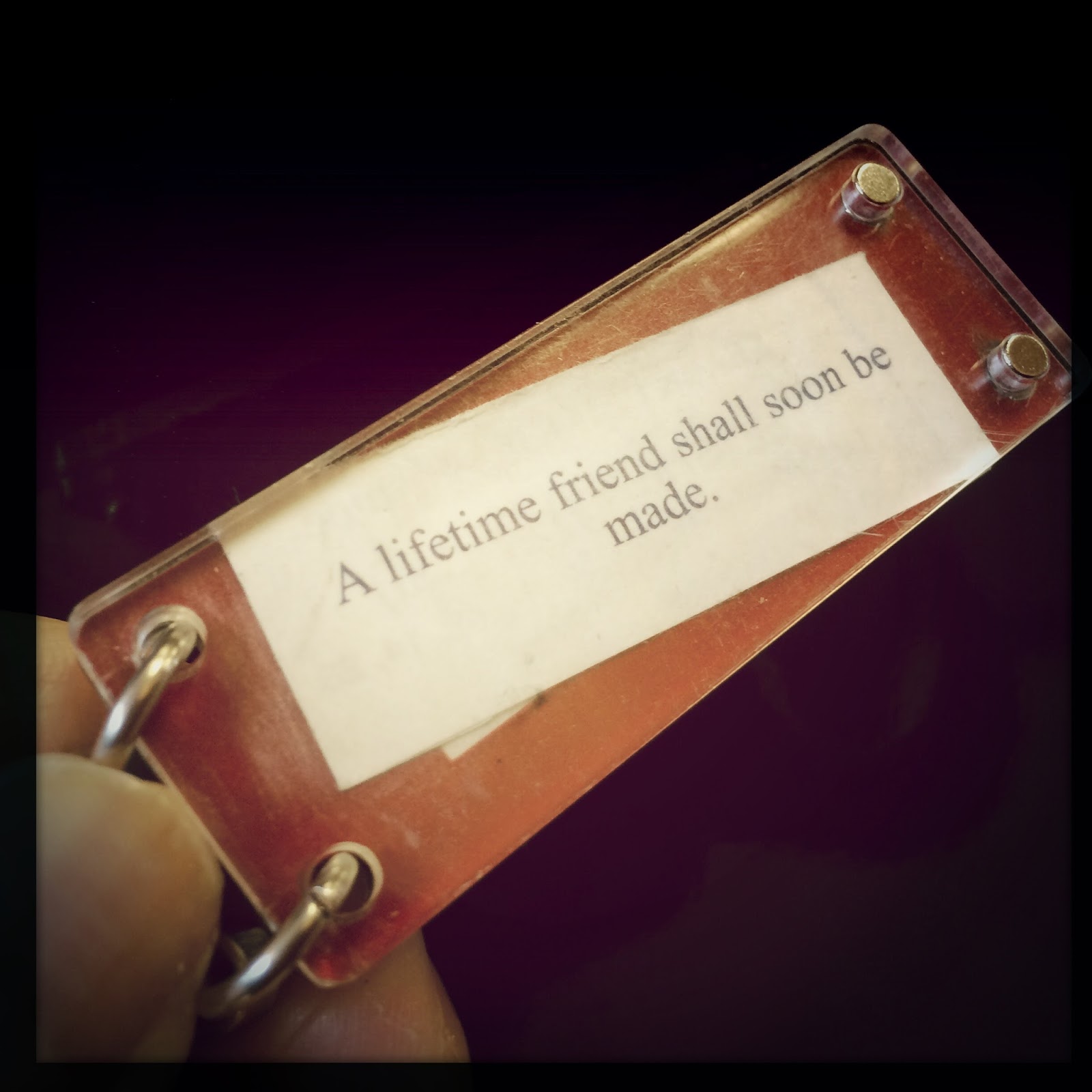
Just before leaving, I opened a fortune cookie to find this:


My friends rejoiced. “See! This will be a fabulous trip!” 

My expectations were scattered. In my mind, I worked through all the permutations. Who I might find or not. Who might want to see me or not. Who might look like me or not. 

I worried about my birth family, my adoptive family and my children. This trip would change me. I knew it. My family knew it. We were all anxious.

But once my feet hit the ground in Incheon, I felt the unspoken comfort of home. Like a long lost relative, John from G.O.A.’L, texted me as I moved through immigration and customs.

I was met with several happy, tired faces. Some spoke English, others Dutch and one French, but our faces were familiar. The next ten days brought personal disappointment and road blocks, wonderful food, many late night conversations at the BOA Guesthouse and a road trip to Gyeongju.

Before I knew it, our time was up. At the end of my journey, I wrote this:

“The plane takes off and tears are streaming from my eyes to streak my cheeks. I close my eyes in hopes of blinding the thoughts and images from the past ten days. The friends are so super special — my new family. ”

I had selected a beautiful handmade paper for my family room from a well-known calligrapher in Insadong. It was carefully rolled and stayed with me but would not fit in my suitcase. In my absent-minded fog, I left it on a counter outside security. Airport staff informed me that I could not retrieve it.

I was devastated. It seemed so silly to feel this way over two sheets of paper. I posted my sorrow on FaceBook. 

My new KAD family of lost brothers and sisters came to my rescue. Two women made it their mission to find the paper as they were checking in for their European flights. The news that they had found it reached me just as I was boarding. Relief and joy overtook me. Not many people would risk delaying a flight to search for two sheets of paper, but these were no ordinary friends. They knew that my attachment to those two sheets of paper was not trivial.

All my life, I was told that I was “chosen,” and yet, I felt out of control. This time, I was surrounded by people who knew my fears firsthand. I had chosen them as family, and they brought great peace to me.


I miss my adoptee family, but now, I am embarking on a new search where the circle of family will widen. Check out this short film by Bryan Tucker, videographer from Closure, that introduces a new book by adult adoptees for teen adoptees and fostered youth. Dear Wonderful You, adoptees are your village.


04 August 2014

The Regression of the Search

The teen years. Everyone has memories of that awkward time. I am reliving it …


Here you have her, the 80s punk girl. The teen years are about identity, experimentation, discovery and disappointment. I spent my time writing, sulking and listening to Depeche Mode. If you asked me then what I would be doing now I would have said, “Living in New York, writing for the Rolling Stone and driving a BMW.”

I wanted out.

Escaping Appalachia meant freedom … from honky tonk bars, from racists, from religious zealots, from closed thinking. I vowed no person (especially men) would “hold me down.” I vowed to hurt others rather than love them, to use and not be used; I vowed I would never marry. Anger and confusion consumed me. I blamed these feelings on my own adoptive parents’ failed marriage. While I loved being loved, I feared it too. I trusted no man.

My fear of love and my lack of trust were broken by my husband. With each burst of anger, he held tighter and embraced me. He withstood my irrational accusations and accepted my bizarre need for order.

He loves me despite feeling confused and rejected at times, and I am thankful for that. I need him. I need a person to whom I don’t irrationally think I need to repay.

Let me be clear. My adoptive parents never insinuated or implied that I would ever need to repay them. All those feelings of indebtedness were my own fabrication, possibly from adoption propaganda imposed by the public or possibly from the religious zealots who reminded me how lucky I should feel to be clothed and fed.

My identity has changed many times over the years from preppy college student to hippy to alternative to goth to wife to mother and now …

Now, I am unsure again. I am unsure of my past … that is, the past I do not remember. I find myself sinking to the regression of my teen years. My adult mind is wrapping itself around these suppressed feelings.

The ones who keep me grounded are my children. It is difficult for them; I know that. I turn to my fellow adoptees for emotional support.

For my family’s sake, I have hid my fears of what may come … fears of finding no one in Korea, fears of finding parents but being rejected again, fears of finding parents and not being able to communicate, fears of finding siblings but no parents living. A piece of me wishes I could just go back to the “bliss” of not knowing … not knowing why I was angry, not knowing why I felt distrust, not knowing why love was so hard an emotion to accept.

My precocious daughter said it best, “Mom, you are scaring me! I mean you act like a teenager with your loud music, wanting a tattoo and joking. Please be an adult!”

I so desperately want that, but yes, in some ways she is correct. While I may play my music loud in the car because my hearing is going, I am back in that teenage discovery mode. I am exploring my identity through art, thinking of a tattoo to accentuate this new identity and enjoying the immaturity of my youth with my teenaged son. That brings me joy for now …

05 November 2013

We are entitled.

Yesterday on a drive around town, my son again opened up the conversation. “I know you are going to hate this, but … ”

These days with a teen, I just never know what is going to be said. One painstaking one was, “I didn’t choose to be born.” Choices. We all have them. Some more than others.

In my teenage days, my stab came in the form of “I wish you had never adopted me.” I’ve been turning all these sayings over in my head, and I regret that last one, just as my son apologized for his.

This week, I was also reminded of my time in Rwanda in the 1990s. Choices in Rwanda were more fundamental. Choices were built on survival. Do you fetch water or go without? Do you trap animals in the forest or go hungry? Western eyes would enter and assess with Western views. Fundamental survival is not a Western worry.

I see parallels in the adoption community. Some adoption agencies and potential adoptive families look at adoption as a way of saving the adoptee. Saving a child from the culture of have nots. But what is it they do not have? A plethora of dining choices? Filtered, bottled water? The newest technology? A chance at fleeting fame?

Much has been said about international adoptees’ lack of gratitude. If a teenage adoptee is not the model teenager (though what teen is), there is the option of rehoming. But what person is grateful when he or she have no choices or too many?

Child adoptees have no choices. They do not choose their parents. They do not choose their futures in families. So what can we do as a society that cares for our children and the future of our world? Listen. The voices of adult adoptees should not be hushed or asked to take a more thankful tone. Adult adoptees are actively looking out for the futures of the young. Choices in the lives of child adoptees need to be mindful and adapted based on past mistakes and successes. 

As a parent, I have parented with a level of choices for my children. When they were small, I realized that my children really did not have the ability to make educated choices, so I often gave them two accepted choices. Now that they are older, I struggle to offer the choices that will ultimately determine whether or not they will make the choice I would. My son is old enough now to see my cracks and flaws and point them out. He sees my choice may not be the best one.


So, his question yesterday ended with “ … I don’t want another phone unless it is an iPhone.” Imagine my frustration. He saw it, then said, “Really, Mom. You love your iPhone and cannot do without it.” Point taken. 

In the 1970s, when Nike became THE shoe, I had a similar conversation with my father. “I don’t want my buddies, I want Nikes!” My parents did not have the means to buy these expensive shoes, so I heard this little ditty as I walked the halls, “Buddies, they cost a dollar-99. Buddies, they make your feet feel fine … ”

My father responded by drawing the Nike symbol on a piece a paper and asked if I might hand him my buddies so that he could draw that coveted symbol on them. Okay, Dad, after all these years. Point taken.


14 September 2013

Children are not commodities.

This week has worn me down. Recent revelations in the media on adoptee re-homing, underground swapping and billboard advertisements filled my inbox.


My initial response was shock and horror, then raw anger. Once again, children are seen as commodities. They are advertised, bought and sold.

What keeps reoccurring is this underlying assumption that children are objects. They are selected, placed, advertised, re-homed, swapped and trafficked. They are the subject of lawsuits where a winner-take-all attitude reigns. And all of this takes money. Those with the funds can do as they please. Forget the young life that is being molded and shaped by these disruptive experiences.

I’m a birth mother. Some may argue that as a birth mother it is easier to love, but I think that if a person wants to be a parent, she can do so regardless of how her parenthood evolved. My adoptive parents are the perfect examples, and I learned so much from them.

For me, motherhood is about loving my children despite what they might say or what they might act out. My mother heard my teen voice angrily say, “I wish you had never adopted me!” I knew it would hurt her, and at that age, that was my goal. When I expressed my regret at having said this, my husband revealed his simultaneous “I wish I had never been born!”

For me, motherhood is respecting my children as they become their own individuals … even if it is counter to my individuality. Motherhood is also about supporting them until they are adults and eventually letting them go.

I will leave you with this lovely New Yorker story of a couple who loved their son unconditionally. More simply put, they felt what their son felt. These parents understood to the point of setting their own desires aside. They loved enough to support (both emotionally and financially) their son’s desire to return to his birth country and his original father.

The Baby Veronica case, re-homing and underground swapping are flooding the media. I am hopeful that this media attention will open up more constructive dialogue and lead to more substantive change.

17 June 2013

The Success Story

Dr. Raible’s words still echo at different points in my days and weeks. One very powerful set of statements keeps playing.

“We are the success stories. But how many of the other stories were silenced by suicide?”

Here’s an account of such a story that was almost silenced.

He was twelve. Another school year was beginning. A new year, a new grade, and an abundance of promises … new books, new teachers, new subjects.

The regulars were present, too … friends, last year’s acquaintances and the same old halls. But this year, everyone was changing … physically, socially, emotionally. Some he considered friends became distant. Some began telling him that his race would exclude him from the relationships they all wanted. The “going together” moniker would be coveted but never his.

He was approached by strangers in the park who would taunt him with words that cut. The seemingly innocuous word, “Chinese” would be said with malice. There would be the pulling of eyes to assimilate his physical racial feature. He felt surrounded by a hate that he did not understand.

The words of others ridiculing him rang through his head. He wanted to hide. He felt alone. He felt he couldn’t tell his parents because they would never understand what it was like to live in his skin.

One night, he waited. He waited to hear the soft quiet of his sister’s sleeping sounds. He waited as his parents ascended the stairs to their bedroom. He could hear them brushing teeth and chatting as they readied themselves for sleep. And then, there was silence.

Quietly, he got out of bed. He took a cord and draped it in his closet. Sobbing softly, he wrapped the cord around his neck. He hoped this would numb the pain of the last few months. He hoped it would silence the voices and darken the images of kids slanting their eyes. He hoped it would give him peace.

As the cord tightened, he sensed a darkness. Unconsciousness washed over him. Then, he opened his eyes. It was dawn. The cord lay on the floor, broken. His tears had dried. Something in him gave him resolve. He rose, got dressed and began another day.

In the days to come, he would talk with his mother about these racial comments. She would console him and try to work through the pain of the words.

His mother would never know the events that lead up to these discussions. She gave her love and advice, but he would keep this secret with him until many months later when his strength had returned.

His is a success story unlike those of us, the adoptee panelists, to whom Dr. Raible referred. The adoption community is awakening; discussions on race are finally becoming relevant, without suspicions or feelings of resentment.

The Korean American Adoptive Family Network recently blogged on the reluctance of our children to talk about issues of race with those they love the most … their families. You can find this blog post here.

Let’s keep the conversation going and add to the number of success stories.

15 January 2013

The Ideal Beauty

Catching up on my podcasts, I heard the most disturbing introduction on This American Life. (This post will address the first 8 minutes of the podcast.)


Teaching at a Korean high school for girls, a young American woman expressed her shock at the vagaries of the Korean teenage girl. While teens everywhere are preoccupied with their appearances, these teens were preoccupied with the ideal beauty they saw in the Western woman.

As I have mentioned here, I, too, wanted the large Western eyes.  So much so, I would paint liquid eye-liner on my lids to create a crease … a crease that these young Koreans want so badly that they undergo plastic surgery. My obsession with my eyes was rooted in my desire to blend into my Western society. Or so I thought.


For these girls, they are surrounded by other Koreans, and yet, they believe the thin, pale waif of a girl in all the Western ads is the epitomé of beauty. They believe it, just as their school master does. He believes these girls should stay thin and places scales on every floor of the building. The girls ceremoniously check their weight throughout the day. If they keep their collective weight down, they will earn a cafe!

The more I listened to the Korean girls, the more I wanted to shake them and say, “Cut it out!  You are beautiful!” But the same can be said of our Western teenage girls. Ads they see are the same that the Koreans view.

I see our worlds are not so different after all. I see that I was trying to attain what every other young Tennesseean girl wanted … to look like the models that graced the pages of Teen and Seventeen magazine. There were few Asians in those pages from the early 80s … trust me, I searched. Today, there are more ethnic models, but even they are extremely thin with more Western features.

This recent movie, Miss Representation will give you a brief sense of where women and girls stand today. (I suggest you screen this trailer before showing it to your children.)


The media have portrayed women and girls in a way that is virtually impossible in nature. I have vowed to teach my daughter that her beauty comes from within. Superficial beauty does not make one a better friend or partner.

However, in Korea, your superficial beauty may be the difference between getting into college or not. While in the end, the girls brought the young American teacher to understand their desires, I am still shocked and unconvinced.