Today, I woke from a restless night. Yesterday, I visited my adoption agency with my children. Again, we were disappointed and left with only a sliver of hope that they would look more to “see if anything in my file stood out.”
But this morning, with sleep in my eyes, I read the words of my Lost Daughter sister, Rebecca. She wrote how my pendant had given her strength and reassurance as an adoptee.
My intention in creating the Pregnant Belly Bowl and its adoptee pendants was to show the community of adoptees. All the pendants were made to be given at first to my Lost Daughters’ sisters. Each takes two hours to carve and polish, then a full day to stoke the fires of the wood kiln. Much work goes into them, but the love and work was worth it for my sisters.
I appreciate their work … their understanding … and most importantly their support when I am feeling weak.
Korea has weakened me. It did last year as I tried to come to terms with the fruitless meeting with my agency. It weakens me today as I roam the streets of Seoul as a temporary resident, a longterm tourist.
I find myself turning my pendant around to the Korean stamp side while I am here in Korea. I find that I just cannot bear to see the sorrow and shame of the viewer once they understand the written word on my pendant.
Once at a ceramics workshop in Wisconsin, a woman said to me, “I am really surprised that you would want to wear that so prominently.” I told her I was not ashamed of being an adoptee. She then said she was an adoptive parent and that the adoptees she knew tried to downplay their identity as such. Then she said something surprising. “You’re brave.”
No, I AM an adoptee.
There should be no shame in that word. It is who I am. I have been made by an original family, a foster family, my adoptive family, my spouse, my children and myself.
Showing posts with label Lost Daughters. Show all posts
02 November 2015
17 June 2015
An Open Letter: Why Co-opting “Transracial” in the Case of Rachel Dolezal is Problematic
Dear readers, please share this letter with those who question the validity of the word, “transracial.” Saying the word “isn’t a thing,” is denying my lived experience as a transracial adoptee. If you Tweet, please use #DefineTransracial.
My sister, my parents’ biological child, would never consider herself Korean, but we both consider ourselves Tennerican. Let that sit a while …
Please direct all media inquiries to Kimberly McKee, PhD at mckee.kimberly@gmail.com.
This past weekend the world took to social media to dissect the events surrounding Rachel Dolezal, the former president of Spokane’s NAACP chapter who came under heavy scrutiny for falsely representing herself as black. As part of this real-time discussion, the term transracial is being co-opted to describe Dolezal identifying as black despite being born white.
As members of the adoption community — particularly those of us who identify as transracial adoptees — we are deeply alarmed by the gross mischaracterization of this term. We find the misuse of “transracial,” describing the phenomenon of a white woman assuming perceived markers of “blackness” in order to pass as “black,” to be erroneous, ahistorical, and dangerous.
Transracial is a term that has long since been defined as the adoption of a child that is of a different race than the adoptive parents. The term most often refers to children of color adopted by white families in the Global North, and has been extensively examined and documented for more than 50 years by academics and members of the adoption triad: adoptees, birthparents, and adoptive parents.
24 May 2015
The Twinkie Chronicles … The Isolation Tank
This girl. She sat in the classroom, mostly alone between two seas … one black and one white. Listening … always listening.
Giggles would explode from one group or another. I would often laugh with the white girls, in hopes of “fitting in.” But when the tables turned and either group would make an Asian slight, I was utterly alone … and left laughing nervously with everyone, hoping it would end.
Recently, at the American Adoption Conference (AAC), I had a similar experience that Lost Daughter sister, Amira Rose documented. It went like this …
“Whoa, there was a hospitality suite? How did I miss that?!” (This was me, joking.)
“Yes, we have been waiting just for you to arrive!” exclaimed the black bartender. I returned his warm smile and said a “thank you.” But then from the only other couple in the room …
“Can’t you read?” asked the white man, deadpanned.
“Yes.” I replied.
“It was in here the whole time. Did you not read this?” he says as he points to the conference schedule book. “I mean, you appear to be an educated woman … ” There was a slight smile and hushed giggle from the white woman. At this, I just needed to flee. I had been here before.
When discussing the many incidents at this predominantly white conference, I messaged this incident to Lost Daughters founder, Amanda Woolston. I had already heard excuses about why the man was “defensive,” how I needed to get a tougher skin and how I needed to get out more. But Amanda changed me. She said the words no other white person had ever said, “If [you] were white, would he have felt so free to be rude, specifically question [your] abilities and intelligence? The power imbalance of a white male speaking that way to a woman of color in a space where most people are white is incredibly hostile and racist.” When I read her words, I sobbed uncontrollably.
My perforated soul … each blow pierces my heart and bruises my self worth. Each time someone says something demeaning, I shrink … go into my hidey-hole.
At the AAC, my fellow adoptee Lost Daughter sister, Angela, asked why I laughed nervously sometimes. I couldn’t really answer her. She then said, “You seem fragile.”
I am. I was. I have always looked at women like Angela and wished that I could feel as strong and empowered, like the united front of black girls from my high school with their confidence and bravado. In the 1980s, I longed to emulate them and Lisa Bonet. Having finally secured a job where I could buy clothes, I began to morph into Denise Huxtable. I shrank from the white girls group that I had once coveted. I found my isolation tank.
The most validating moments of my senior year in high school came from the black girls. They wrote me beautiful, sincere notes in my yearbook.
In the Dear Wonderful You video, I speak of this cyclical self I created. Over and over again as I entered a new environment, I began my cycle as an outgoing, white wannabe. I did whatever it took to assimilate. Polo shirts … check. Join a fraternity little sis group … check. Be the graduate school student representative on committees … check.
But none of this worked. The off-hand comments, the “you almost look normal,” the references to Yoko Ono or Connie Chung, the tokenism of being the “model minority” … all served to place me below the white privilege. Eventually, I would shrink and hide.
In this solace of aloneness, I would find my voice again and reemerge strong, yet guarded. Each new environment or new acquaintance began the cycle again.
Today, Twitter has allowed me the freedom to speak strongly and hide, while here on my blog, I reveal more of my vulnerabilities. Having these two parts of myself is exhausting.
Each tweet or means of speaking out gives me so much validation and relief, but then, the adoptee guilt and adoption loyalty set in. In public spaces, I use walls, podiums and my reading glasses to separate myself, protect myself and hide in the open. I use laughter and my comical façade to mask my pain and humiliation.
As the Lost Daughters take to the road and do more speaking engagements, I fear the notice. I hide in my room. I realize I like the loneliness and isolation. It’s comfortable and safe.
And yet, I know that by hiding I am not claiming my space to be heard.
The valve on the radiator has held back long enough. There have been long pshhhhhhhhts and short, angry spurts of steam. Pressure is building.
This cartoon from Empathize This illustrates what is brewing in many of us.
As the Lost Daughters take to the road and do more speaking engagements, I fear the notice. I hide in my room. I realize I like the loneliness and isolation. It’s comfortable and safe.
And yet, I know that by hiding I am not claiming my space to be heard.
The valve on the radiator has held back long enough. There have been long pshhhhhhhhts and short, angry spurts of steam. Pressure is building.
This cartoon from Empathize This illustrates what is brewing in many of us.
Shared with permission from Empathize This.
24 March 2015
#DearMe, speak your truth.
I am truly grateful for the community of adoptees.
When I first became aware of the #DearMe campaign, I posted a suggestion on Facebook that I thought this campaign and its work with young people reflected the mission of Dear Wonderful You from the AnYa Project. I also suggested that we make our own videos to support our younger selves.
Thanks to Diane Christian of the AnYa Project, Kimberly McKee of the Korean American Adoptee Adoptive Family Network (KAAN) and Amanda Woolston of The Lost Daughters for bringing this small dream to fruition.
For all the beautiful young adoptees out there:
24 October 2014
Korean Kin, Part 3 (final)
When I feel lonely, I turn to my Lost Daughters sisters. They know my pain, my confusion and my sadness. When G.O.A.’L asked me if I would have emotional support when I returned home, I said that my Lost Daughters sisters were my family and my support.
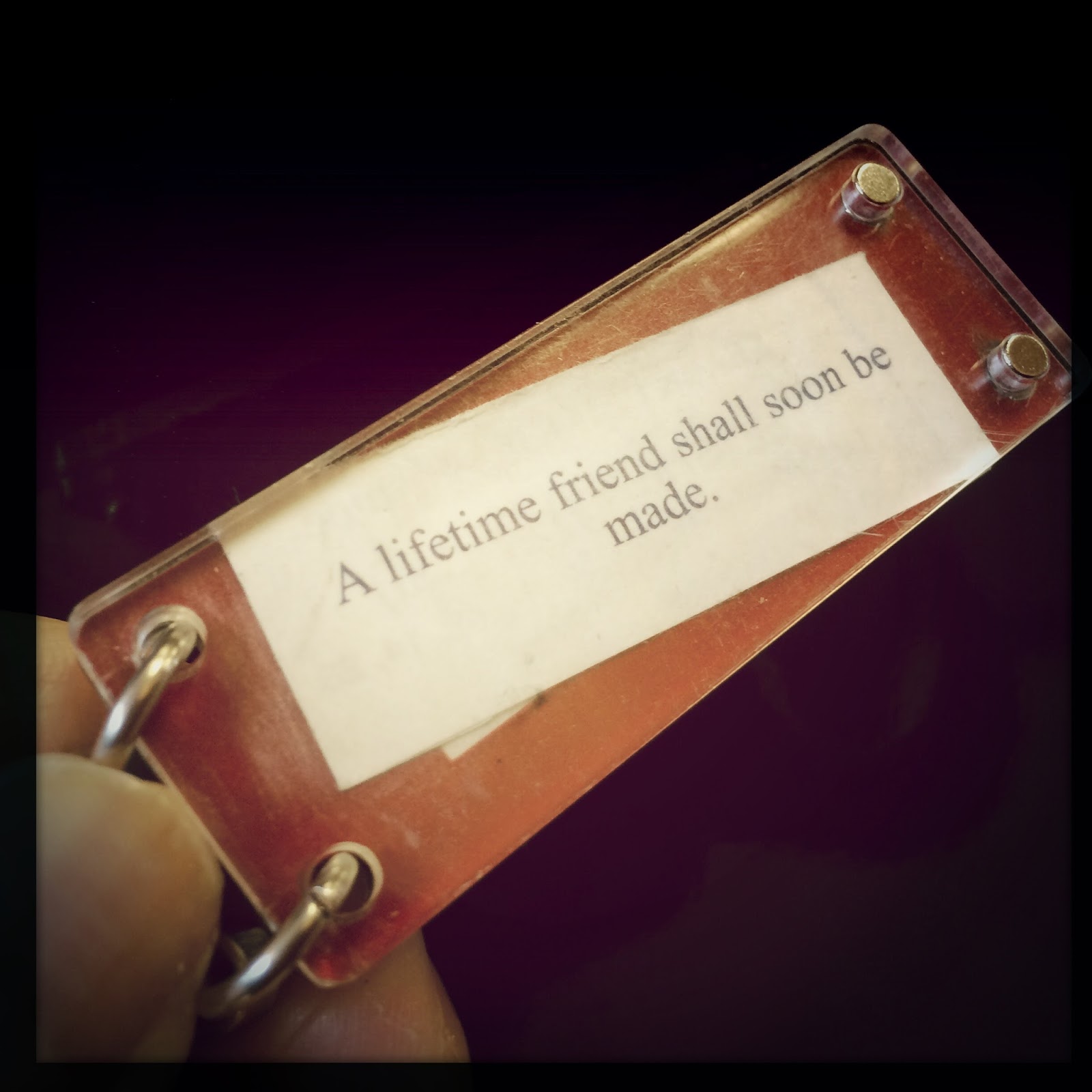
Just before leaving, I opened a fortune cookie to find this:
My friends rejoiced. “See! This will be a fabulous trip!”
My expectations were scattered. In my mind, I worked through all the permutations. Who I might find or not. Who might want to see me or not. Who might look like me or not.
I worried about my birth family, my adoptive family and my children. This trip would change me. I knew it. My family knew it. We were all anxious.
But once my feet hit the ground in Incheon, I felt the unspoken comfort of home. Like a long lost relative, John from G.O.A.’L, texted me as I moved through immigration and customs.
I was met with several happy, tired faces. Some spoke English, others Dutch and one French, but our faces were familiar. The next ten days brought personal disappointment and road blocks, wonderful food, many late night conversations at the BOA Guesthouse and a road trip to Gyeongju.
Before I knew it, our time was up. At the end of my journey, I wrote this:
“The plane takes off and tears are streaming from my eyes to streak my cheeks. I close my eyes in hopes of blinding the thoughts and images from the past ten days. The friends are so super special — my new family. ”
I had selected a beautiful handmade paper for my family room from a well-known calligrapher in Insadong. It was carefully rolled and stayed with me but would not fit in my suitcase. In my absent-minded fog, I left it on a counter outside security. Airport staff informed me that I could not retrieve it.
I was devastated. It seemed so silly to feel this way over two sheets of paper. I posted my sorrow on FaceBook.
My new KAD family of lost brothers and sisters came to my rescue. Two women made it their mission to find the paper as they were checking in for their European flights. The news that they had found it reached me just as I was boarding. Relief and joy overtook me. Not many people would risk delaying a flight to search for two sheets of paper, but these were no ordinary friends. They knew that my attachment to those two sheets of paper was not trivial.
All my life, I was told that I was “chosen,” and yet, I felt out of control. This time, I was surrounded by people who knew my fears firsthand. I had chosen them as family, and they brought great peace to me.
I miss my adoptee family, but now, I am embarking on a new search where the circle of family will widen. Check out this short film by Bryan Tucker, videographer from Closure, that introduces a new book by adult adoptees for teen adoptees and fostered youth. Dear Wonderful You, adoptees are your village.
Labels:
acceptance,
adopted,
adoptee,
adoptees,
adoption,
alike,
Closure,
Dear Wonderful You,
family,
friendship,
G.O.A.’L.,
Lost Daughters,
search,
teenagers
28 June 2014
I never feel enough.
Our family drove to Minneapolis this weekend on a quest to find out more about my adoption. The mood was jolly as we road tripped. I was excited for our first adoptee conference outing as a family.
We settled in with our Doubletree cookies and name tags for the KAAN 2014 conference. “Nice,” I thought.
For dinner, we split off: me to the adoptees-only dinner; the rest to the community dinner. I had been anxiously awaiting the dinner. As you know, I enjoyed the Adoption Policy and Reform Collaborative Conference in November. I found my family in the women of the Lost Daughters. My visions of my family and I finding our niche were on the verge of validation.
Fitting, assimilating, blending … my entire life, I have wanted that acceptance. But my own notions scare me. I briefly said hello to a few adoptees and then sank into solitude as the young adoptees around me talked and reconnected. I was finally the majority race on this shuttle to dinner.
What should have been gratifying and fulfilling soon became oppressive. I suddenly began to feel less comfortable surrounded by so many Asians. I felt the panic I felt as a child when I was paired with the only other Asian boy.
I didn’t feel a part of this group of adoptees. I frantically texted and posted to my husband and my Lost Daughters’ sisters. I was aching. Many on the bus were Minneapolis adoptees who knew one another. Others were well-known in the KAAN circles; they had their connections. They all seemed so happy and well-adjusted. Laughter and conversation filled the bus.
Something inside of me felt cancerous. I was consuming myself in panic; my eyes were welling with tears. I felt less Korean … less Korean adopted.
Luckily, I found two friendly faces from the Adoption Policy and Reform conference at the restaurant and began to relax.
Sometimes, I feel my background of Southerner, Puerto Rican, Asian and white conflate and confuse me. It is as though I cannot decide what identity to wear or where I fit. I never feel enough of anything.
This morning, I met up with my Lost Daughter sister, Kripa. She became my anchor and helped me realize that sometimes, the best thing is to be who you are in that space and moment. I’m trying!
Labels:
acceptance,
adoptees,
adult adoptee,
friendship,
identity,
KAAN,
Kripa,
Lost Daughters,
race,
white
19 November 2013
Adoptees are a family.
As an adoptee, there are so many people who create your sense of self … adoptive families, birth families, and most importantly, adoptees. The latter has not come into fruition for me until this year. In September of last year, I met my first Korean adult adoptee. It was a serendipitous meeting.
So much has happened in this last year, but the cap to this year has been my connection to the Lost Daughters. I have learned so very much from them. The stories are all so different, but then again, so familiar.
How we got here has shaped us, and we continue to grow. The internet has granted us access to so many people. Again, only this year have I dived into the sea of social media; the wading has ended.
This flood of people has taught me so much about the struggles we all have … struggles with seeing our original birth certificates, struggles in not having birth certificates, struggles in blending two very important families into one.
Adoptees converged on St. Paul this weekend for the Adoption Policy and Reform Collaborative Conference. My drive to St. Paul had me in a twist of ambivalence. I feared rejection again from the group for having loved my adoptive parents, rejection from having not searched for my birth family, rejection for just being me.
What I discovered was a group that welcomed and enveloped me, as tentative as I was. We are our comfort. Thank you, adoptees.
So much has happened in this last year, but the cap to this year has been my connection to the Lost Daughters. I have learned so very much from them. The stories are all so different, but then again, so familiar.
How we got here has shaped us, and we continue to grow. The internet has granted us access to so many people. Again, only this year have I dived into the sea of social media; the wading has ended.
This flood of people has taught me so much about the struggles we all have … struggles with seeing our original birth certificates, struggles in not having birth certificates, struggles in blending two very important families into one.
Adoptees converged on St. Paul this weekend for the Adoption Policy and Reform Collaborative Conference. My drive to St. Paul had me in a twist of ambivalence. I feared rejection again from the group for having loved my adoptive parents, rejection from having not searched for my birth family, rejection for just being me.
What I discovered was a group that welcomed and enveloped me, as tentative as I was. We are our comfort. Thank you, adoptees.
Enveloped by the Lost Daughters.
With my Lost Daughter sisters.
With Deann Borshay Liem of First Person Plural.
With Fang Lee of Somewhere Between.
09 September 2013
The Kindness of Strangers
Remember that line from Tennessee Williams’ play, A Streetcar Named Desire? Blanche DuBois, spiraling out of control, reaches out to the doctor who is taking her away, saying, “Whoever you are, I have always depended on the kindness of strangers.”
I have said this to myself often. Initially as a teenager, I made the connection with Blanche because of her accent. It seemed the southernly way for the women in Tennessee. We quoted her and spoke in our thickest accents.
Later, I realized the tragedy of Blanche’s life. As a feminist, I understood hers was a life to be avoided. And yet, in my early college days, I played out many of Blanche’s foibles. Some of my anxieties were rooted in my feelings of racial inadequacy. Unlike the Asian attraction on the West Coast, most in Tennessee were more repulsed by me than attracted.
Unlike Blanche, I did find love from a young Liverpudlian. What attracted him to me was his lack of American male “Stanley” qualities. He respected me as an equal. (I always hated when men would open the door for me. Frankly, they were obstructing the doorway.)
Like my relationship with my adoptive family, I have noticed that I seek deep, family-like friendships. Since beginning my writing for the Lost Daughters, I see similar things happening among them. They are like sisters. Is it that we, as adoptees, have so readily accepted strangers as family, that it makes our friendships more complex?
Over the years, I have adopted additional family members … Kayla, LaDawn, Patrick, Alberto, Jules, Jenny, Marlene, Kathy, Katherine, Adrienne and now Amy. They are my sisters and brothers. They have accepted my Blanche-like ways. Those who haven’t? Well, my adoptive papers show the darker side of my psyche:
I have said this to myself often. Initially as a teenager, I made the connection with Blanche because of her accent. It seemed the southernly way for the women in Tennessee. We quoted her and spoke in our thickest accents.
Later, I realized the tragedy of Blanche’s life. As a feminist, I understood hers was a life to be avoided. And yet, in my early college days, I played out many of Blanche’s foibles. Some of my anxieties were rooted in my feelings of racial inadequacy. Unlike the Asian attraction on the West Coast, most in Tennessee were more repulsed by me than attracted.
Unlike Blanche, I did find love from a young Liverpudlian. What attracted him to me was his lack of American male “Stanley” qualities. He respected me as an equal. (I always hated when men would open the door for me. Frankly, they were obstructing the doorway.)
Like my relationship with my adoptive family, I have noticed that I seek deep, family-like friendships. Since beginning my writing for the Lost Daughters, I see similar things happening among them. They are like sisters. Is it that we, as adoptees, have so readily accepted strangers as family, that it makes our friendships more complex?
Over the years, I have adopted additional family members … Kayla, LaDawn, Patrick, Alberto, Jules, Jenny, Marlene, Kathy, Katherine, Adrienne and now Amy. They are my sisters and brothers. They have accepted my Blanche-like ways. Those who haven’t? Well, my adoptive papers show the darker side of my psyche:
Labels:
adoptees,
adoption,
Asian attraction,
family,
friendship,
husband,
Lost Daughters,
Southern drawl,
women
Subscribe to:
Posts (Atom)