I began this video in 2021 and just couldn’t finish it. Since starting it, we have lost two other cats here in the US.
With each death, I have seen the differences in how death is handled. In Korea, the vet would not allow me to comfort this sweet boy to the beyond. But there was much respect in seeing him cremated.
When my Obi fell sick suddenly, the emergency clinic allowed us time with him as he rubbed against the glass door of his cage. As they lay his body on the stainless steel table, I whispered my love for him. He wanted to be home, but the emergency vet quickly administered the drugs. After Puck’s, I felt thankful to at least have Obi know I was with him. But when I asked to witness the cremation, I was told I would only be able to sit in my car on the grounds of the crematorium. That closure wouldn’t happen.
I suppose everything is relative. When Jilly Boo became ill, our clinic was very mindful of how painful these moments are. We scheduled time, they administered drugs to relax her in a cozy kitty bed. Once they knew she was relaxed, I spoke with her and could see her respond to me. The vet positioned that they would administer the drug as I stroked her. I slowly saw her third lid close and her spirit left. That was the most peaceful ending.
As I left, I knew that if I had to do this again, I finally knew how the final moments should play out. I hope that when my time comes, the world will be just as kind to my soul.
In July of this year, I was invited to present at the Third BTS Global Interdisciplinary Conference at Hankuk University in Seoul.
While I was unable to get a video of the original presentation, I wanted to give it a chance to be seen by others … transracial adoptees, ARMYs, first generation Asian Americans. It’s important to love ourselves and to find others who understand our experiences.
Perfection. I spent my childhood building it. I built it shiny and covetable. I built it in my marriage and in my parenting skills … until I realized that when it encompassed others, I couldn’t control them. My perfection began to erode my relationships.
From day one, I expected perfection from others because I had attained it through adversity as an adoptee. I wasn’t exactly calculated in my demands … it was just my normal.
As I began to learn more about myself, that ceramic, happy adoptee façade cracked and all my demons came spilling forth. After my first trip back to Seoul, I regressed. I slept in a deep depression. I came out the other side a very different person. The perfectionist died. But she still expected those around her to perform.
Often, I hear, “Why does everything come back to adoption? Do we have to talk about ‘adoption’ again?”
Honestly, I wish I could live a fairytale life in which I was born of a mother and father, and we lived out our lives as such, without questions about my past culture, the shame of not knowing my native language and the peace of just being me. But I was not dealt such a fate.
Loving me is very hard. I expect a lot. After 25 years, a couple is not the same two young hearts they once were. In my case, I am not the person my husband married, not even close. I am cheating on him, and Korea is my concubine. When she is absent, I still imagine her lying next to me, feeding me the fruits of her landscape. My thoughts of her interrupt my life and fill me with loneliness and sorrow.
A couple of months ago, my husband excitedly planned a trip to Thailand (A country that is top on my bucket list.) with a Seoul weekend prelude. Initially, I was thrilled at the prospect of spending time alone with him in my home country and in Thailand. We haven’t had time to ourselves like that since having our first child in 2000.
When I land on South Korean soil, I find my feet firmly planted. I can feel the roots, once pulled, trying to re-root in the cracks of Korean pavement. My weedy self took hold this time and couldn’t be uprooted after my first full day back in Seoul. The thought of leaving without a thorough examination of my search … well … I just couldn’t leave. I broke down sobbing our second night. I begged to stay with my concubine. She was demanding that I not leave, not just yet.
I cannot deny my guilt of having neglected her for more than 40 years. She gave me life, and I was ripped from her grasp. I am trying to make up for our lost time … at the expense of my marriage.
I carelessly changed my travel plans and took root at KoRoot, the adoptee guesthouse. This move was selfish. It was. I could only think of her … my concubine. She flooded my mind.
My decision hurt my husband. He has taken a lot from me in the last 25 years. He is my true love, but I abused his love. He wanted time with me, and I chose Korea.
A week ago, I collected lots of Puerto Rican music to remind me of my father.
His loss permeates my soul. He was my anchor in much of my life as a person of color. His love and caring sustained me in my darkest moments … because he understood my sorrows. He gently told me his stories of discrimination and then brushed them off. That is how he survived, and I learned to do the same.
Since his death, I feel so very lost. I need him now. His love surrounded me when I struggled with my role as a mother. He reminded me how very proud he was of me. As much as anyone else said it, I needed him or my mother to say it. As an adoptee, the love and approval from our elders is everything. In most cases, the only people who fill that space are our adoptive parents.
I have searched for the other parents … my original family and my foster family. They hold the key to many of my beginnings. They are unknowns in the crowded subway system in Seoul. In Seoul, I felt their presence in the biological resemblance that surrounded me.
In Wisconsin, I am left to create a space of safety and love. That is our home. So, a few days ago, as I listened to salsa music and did my cleaning, my daughter stopped me to take my picture in the old way … with a Polaroid camera.
There he was. My father was dancing with me as a light. I posted it, and some explained that it must have been a light somewhere or that the camera had something on the lens. But no other photograph she took that night had the same light.
Self-doubt is a terrible thing. But it sank in … the idea that there was a perfectly good explanation for the light.
Then, one of my favorite authors, Sherman Alexie, released a letter about his own loss and his encounters with his late mother. Well, now, I know my father is with me still, and we salsa through the house at all hours!
In a few weeks, I return to the Republic of Korea.
The trip is a gift from my husband. When he announced that he wanted to give me the time and space to explore Korea on my own, my soul just about leapt from my body!
Since our return to the United States last February (2016), I have floated about, not fully engaged in my surroundings. It was lovely to be back in my house, but I still felt completely unsettled.
As time has passed, I have noticed my sense of loss but not sorrow. I was numb. Yet, my physical body began showing signs … the breakdown of age and heartache.
Returning to Korea is my reset button. I need this country more than it knows.
And yet, with the timer ticking down … my anxiety has risen. My voice is short. I overreact.
Living with me must be hard. I come home from work and just gaze into my cat’s eyes. That calms me. It is true what they say about pets … and then, I remember the trauma of my final days in Seoul and the loss of another sweet kitten boy.
2017
2016
This is not how I want to feel about returning, but my mind gives me no choice. Trauma and comfort swirl with every step towards a return.
I know all my anxiety will dispel just like my current time zone in a few days in Seoul. Old friends will help me feel more like my Korean self. The scents will welcome me home, and the kimchi will nourish me.
But I also anticipate the desperation I feel when I sit across all those lookalikes on the subway. I dream, hope and wish that they were relatives searching for me and would approach me with … “How we have wondered what became of you and if you were well!!!”
Today, my Seoul mates celebrated the Lunar New Year together in the house that is KoRoot, a home to adult Korean adoptees from around the world. Having no extended Korean family to visit, I stay snug in my Wisconsin home as I think of my fondest memories from this last year of the sheep.
People flood my mind now when I think of our time in Korea. From our home station of Sinjeong, Exit 1, to our two-bedroom apartment on the fifth floor of a business building, we miss the produce stand outside the exit with the man who shouted, “Hello! How are you!” even though he never really wanted an English response so we let a smile suffice. (He had studied in southern California back in the day.)
From there, we passed our local grocery. Outside, the man who wears the headpiece to announce the sales would also smile. For the first month, he said, “Annyeonghaseyo.” But soon, my son noticed when the man switched to “Annyeong,” the informal “hello.” We were in.
Many of our anxieties of not fitting in were tempered with these subtle social nuances.
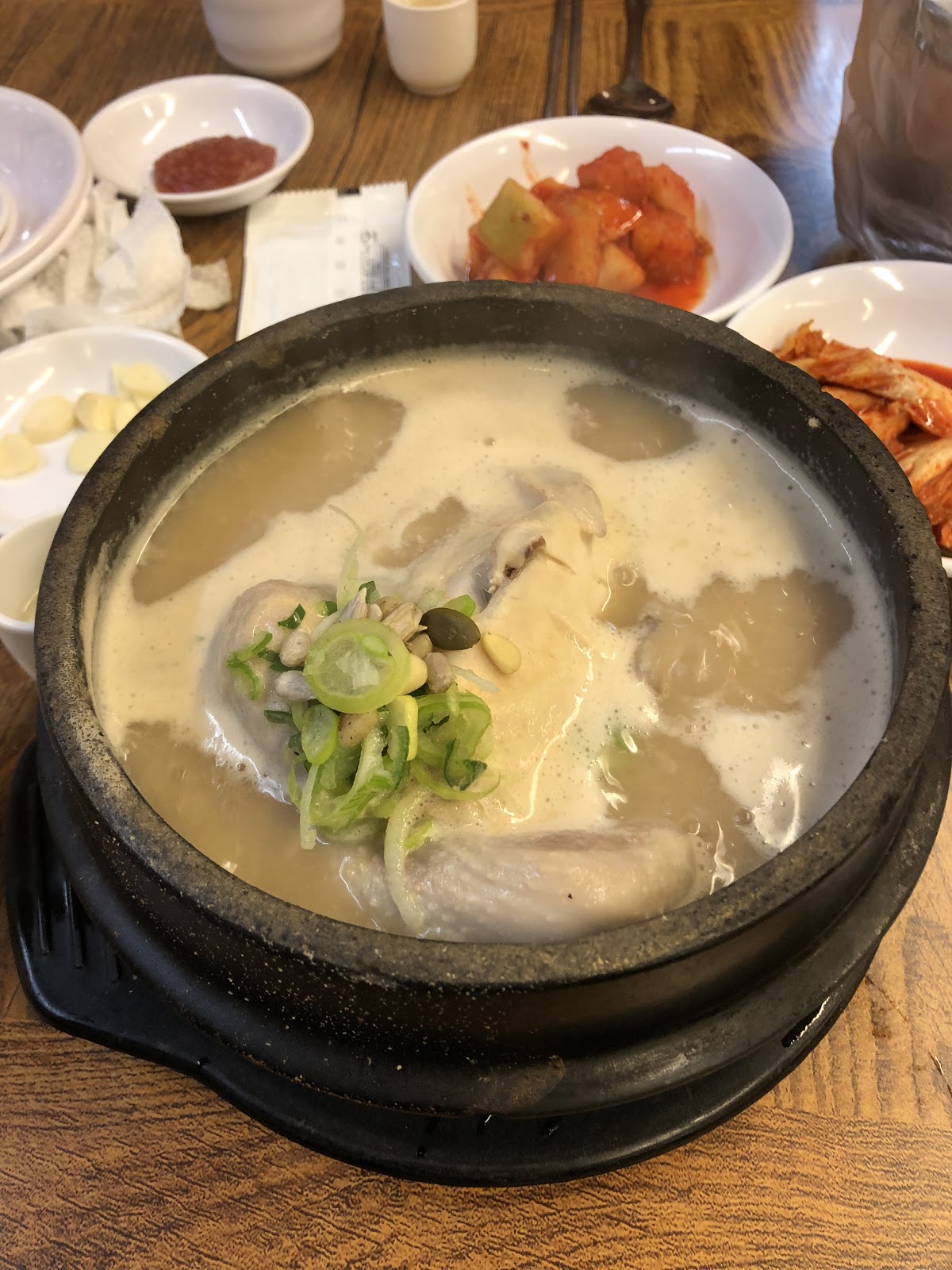
Today, this Seollal celebration in Korea is filled with my favorite dish … tteok guk, a rice cake soup.
This one in particular was made by a woman who runs a small restaurant, Mananim, on the outskirts of the Hanok Village (Anguk Station, Exit 1, take a right and walk down the alley-like road).
My first time there, our host friends ask that I go ahead of the group, to see if she would speak Korean to me. Of course, she did. But when she realized I spoke English, she switched effortlessly into a kind, gentle voice. Other Koreans were met with her usual commands.
She keeps a tight ship as the only employee of this restaurant, and I loved her spunk as she told us how to help ourselves to water and how to order (tiny sheets of scrap paper and a pen to write your own order).
Once the order was in, her hands got messy as she cooked each dish to perfection. She introduced the dishes filled with organic ingredients and beautifully presented Korean herbs. She carefully used chopsticks to unfold the leaves of a native Korean pickled herb for my husband’s pork belly.
As the dinner progressed, I told her my soul felt fulfilled. I felt at home and embraced by the warmth and comfort of my tteok guk. Its flavors of egg, chicken and rice cake hugged my tongue just before filling my belly. There was a knowing, but not knowing comfort in that bowl. I finally felt comfortable in telling her that I was an adoptee … a forgotten child of Korea.
She hugged me and said, “I knew that.” I snapped a selfie just as we left. But I would return to her restaurant several times as a lost daughter of the tteok guk, and she would welcome me with a warm embrace.
Another poignant meeting would happen at Icheon in my pilgrimage to the Ceramics Village. Having seen the work of so many Icheon masters, I wanted to visit and pay homage to those who carried on the traditions of Korean pottery.
One artist in particular, Jeon, Seong-Keun, had fascinated me. His work of carving porcelain made me feel a part of Korean ceramic culture. I wanted to meet him.
As I looked around the showroom, there was awe and inspiration. A young man stood minding the shop. I finally had the courage to ask him if the artist was around. I watched as his face dropped. Sadly, he introduced himself as So Bin or Alfred, the son of the recently passed Seong-Keun. I felt horrible. I shared with him that I knew the pain of loss as my father had passed the same year, and we shared a moment of tearful reflection.
This opened up so much conversation. He had studied in New York when his father was living, but now, he was back to help his mother with his late father’s studio. His brother, So Hyeon was living in Seoul. As I left, he gave me two cups from his late father’s collection, something I will treasure for years to come from that one moment of shared loss.
Each person in Korea that reached out to me, embraced me and connected to me in someway became a part of my village. As I reflect on the new year, this monkey one, I know my time in Seoul will not be my last. The leaving was bittersweet. While I enjoy the comfort of my home in Wisconsin, I miss that familial feeling of belonging to a village that is mine, despite what any paperwork will say.
“Ain’t she just the cutest ‘China doll’! You’ns must be mighty proud of her.”
My mother’s face would mangle and turn blood red, no matter who said it. “She’s my daughter, and she’s Korean, not Chinese.”
This was the dialogue when we would return to my mother’s hometown in the 1970s. She actually never wanted to return to that small town but wanted a life in a larger community. My parents had lived in Yokohama, Japan, for three years, and my mother longed to have those days back.
Yet, in 1976, my father, thinking it would be nice for his wife to have her mother nearby, pursued a job in my mother’s hometown. And thusly, my life progressed there, amidst the racism and ignorance of the small-town mentality. It pains me to even type this, as I still have relatives there who I love dearly and would do anything to protect. Their love for me is unconditional, and here, I leave it at that.
After escaping my hometown, I moved to the city that started my parents’ romance … Knoxville. It was bigger and brighter; there was more dialogue, and I relished the “changes” I hoped to see for my home state during the 1992 election.
Much of that optimism fell as I returned pregnant in the late 1990s. My husband and I stayed with a friend that holiday season in Knoxville. During our dinner, my friend’s husband said something that froze me to the core … “You guys will make a beautiful baby. Hybrids are attractive and robust genetically.”
We were shocked. Our marriage and our family planning was never an experiment in procreation. If I had had the words then, WHAT. THE. FUCK.
Our planning did include communities with larger populations of people of color. We wanted our children to not feel the isolation I had as a child. But even the best intentions never prepare you for the reality of racism and race comparisons.
Now that my children are growing taller than me, I find myself gushing over all infants and toddlers. I long for those days. My daughter, the youngest, has a difficult time watching this crazy behavior where I smile at strangers’ children and hold and then sniff our friends’ infants.
Since coming to Korea, her disgust of babies has changed to fear. My daughter now senses my complete connection to the little ones here. Where I see little versions of what I could have been, my daughter sees versions of what she thinks I want.
Difficult to tease out with her, she and I only talk briefly. She talks mostly to her father about her fear that I will remain in Korea and marry a Korean man to have Korean children. She does not see the complexities. All I can do is reassure her.
The worst struggles come when other Korean adoptees gush over her and her brother. They compliment them on how beautiful and handsome they are. And one well-meaning person once said, “I guess I would have to marry a white man to get beautiful children like that.”
Though the person did not realize my daughter was listening (she and her brother tend to keep ear buds in and eyes on screen) her ears were burning. She wanted reassurance that my motives were pure. She wanted reassurance that I loved her father.
I assured her, but I also elaborated on why a Korean adoptee looks at her with such longing.
“Before you and your brother, I had no other person that shared my appearance, my mannerisms and my genetics. Korean adoptees who have yet to have children of their own are curious. They long to see themselves reflected in another human being. That does not excuse the comment or how it makes you feel. Your father and I love one another, and we love you and your brother. We are a family.”
In 1995, my husband and I moved to Rwanda, just one year after the genocide that took more than 800,000 lives in 100 days. We arrived to find shards of glass on the walls of our compound and metal gates with gatekeepers. It was a country still in conflict.
Expatriates were advised to take R&R frequently. I was naive and visibly shaken all the time. Every stream or stairwell had my mind racing with dead bodies and floating limbs. I could not shut the memories of the loss that played out on every face I met.
In those days, our place of respite was Uganda. After going through all the roadblocks with machine-gun totting teenage boys rifling through our washbags, we would finally cross the border where we drove on the left and let out an audible S-I-G-H of relief. Every muscle in my body would relax.
Today in Seoul, I feel the same stress taking hold of my body and squeezing me tightly. Just walking down the street can be stressful. Seoul is certainly not dangerous, but the trauma of original family loss is the same as a death.
In October, after six weeks in Seoul, we took a much needed R&R to the southern tip of South Korea, an area called Namhae. After a long car journey, we settled with our three kitties in the hotel. We explored the Buddhist Temple and the serene mountains which reminded me of my life in the Appalachia. I felt at peace again. When I find that peace within myself, the sweet yielding to my fate and acceptance of the known facts veils my anxiety.
I stood outside of the Boriam Temple, gazing in. The people in the temple were at peace, quiet and reflective. I entered the area where you take off your shoes, but I stopped there. I yearned to enter, but I felt paralyzed by my guilt. Once again, I was reminded that I was an outsider, no longer connected to a faith that may have been my own.
I stepped outside and took this image … a shadow of myself looking in and wishing to be a soul on the wall.
No one wanted to leave once our three days were up. I had made the audible S-I-G-H as we left the city limits of Seoul. Crossing over again, meant that I would tense up … my irrational Mom outbursts and control issues would return. The triggering faces and crowds of Seoul would once again hit me head on.
Since returning, I am tighter than ever. I visited my adoption agency, but that experience will need to wait for another post. I do not have the energy to address that.
This week, we celebrate the one American holiday I love … Thanksgiving. Thanksgiving means a homecoming, much like Chuseok here in Korea. My home is ambiguous. What made “home” was my mother, father and grandparents; they are no longer living. My kids now love the holiday for their father’s roast dinners, but here in Korea we only have a microwave.
So, our family is heading to Japan for Thanksgiving. Japan is where my parents lived when the plane from Korea brought me to them on a chilly day in December. Japan holds the loss of my parents’ first born, stillborn son and the beginning of my life as a puertorriqueña. Japan revived my parents’ marriage in the wake of my father’s lost son.
I am looking forward to that deep S-I-G-H as our plane lands.
Since the death of my father, my shell has hardened. There are few things that make me cry …
My children have seen me cry so few times, that when I cry, it terrifies them. I broke down the first week we moved to Seoul, but not necessarily because of sadness. My tears flow because of hurt. I have explained to them, that meetings with agencies will NOT bring tears. Tears here are reserved for those I love. Tears are for the lost connections.
Last night, I attended the puppetry artistic performance, “Untold Story,” about an adoptee named David. There were three very beautifully crafted puppets for the toddler David, the teen David and the grown man David. Five actors of the Pangaea Arts worked the stage, the puppets and acted scenes in David’s life.
Each scene plucked a memory from my mind. The most poignant “core memory” was the airplane ride back to Korea as an adult. All the things that David experienced, I lived and relived and continue to relive as I walk the streets of Korea.
The complexities of adoption played beautifully as though I were watching scenes from my own life … the tenderness and wanting of the adoptive family, the scenes of teasing, the isolation amidst so much love. All these scenes added to my quilt of comfort, another layer in the adoptee community.
After the performance, Pangaea Arts invited the KoRoot group back to the dressing room to see the puppets. There was joy and excitement to see the puppets.
But then, the performance group asked us for our feedback. They wanted specifics of how we, as adoptees, felt. Moments like this are often few online, so I am always taken by surprise when someone who isn’t an adoptee wants to know my opinion!
One person in our group, of whom I had never met and who spoke Korean, spoke up. She had cried and embraced the life-sized David. I felt for her and fought my physiological urges to cry. But then, as someone translated, I sobbed.
Her words were the words I needed to hear from someone all my 48 years. She said she had given her baby boy to my adoption agency, and she had been searching for him. He is currently 26 years old. As my agency has blocked me, it has blocked her from connecting with an adult son.
She shook as she told how she had been told her son would “have a better life” and that she had believed this for so many years, yet the scenes of bullying and the ever present “Where are you from?” question broke her. She never wanted her son to feel disconnected from her and his country. She never wanted him to feel the pain adoptees express. She said she would “have this hole in her heart” until she could see him again.
I moved closer to her and had Pastor Kim translate. I told her that her strength in this situation would be passed to this son. That we, adoptees, are looking for our mothers and have never forgotten them. I also told her how I wished she were my mother. We embraced and cried together.
As I left the theatre, I was angry with myself at first for crying and I muttered, “I don’t usually lose my shit in public, unless I am angry.”
Tears are not shit. Tears are more valuable. Tears mean we feel. Tears mean we care. Tears mean we are connected.
In the first few weeks of our move to Seoul, I celebrated and explored the Korean culture with my small family, but as my persona moved from a tourist to a resident, my mind couldn’t keep up.
There is joy, comfort, sorrow, confusion, frustration, betrayal and anger.
I hope to write more in the coming days to properly celebrate #FliptheScript, and all it did to bolster the adoptee voice. For now, I leave you with tweets from my days …
A whirlwind of planning, setbacks and finally a day of “what
happens, happens” lead our small family of four (plus three, very patient
kitties) to our Korean Air flight. The week prior had held the wrong person’s
nightguard not fitting my mouth, the boy’s fractured bone and non-compliant pet
micro-chips.
Once the bags were in the van, my friend, Cynthia, at the
wheel, and a trio of crying cats cruising down the highway, my mind shut down.
I wanted to chat those last minutes with my friend, but I was physically and
mentally spent. I immediately fell asleep.
Since my father’s death and the subsequent news of an older half-brother, my life had no time to tailspin. I held it in, again. Small
releases of steam came out as cursing at kids and small grown-up tantrums. My
remaining little family had been tolerant, but I felt selfish in not allowing
them the time to process this trip with me. Shit,
I didn’t have time to process.
I have been silent in my sorrow … silent in my fears.What if my children hate Korea? Will they
hate me for the yearning my heart has had since my first trip back last summer?
As the lights dimmed on the plane, and my daughter fell fast
asleep, the tears ran down my face. We had done it. We were making that
pilgrimage to the place of my birth … the place my father loved … the place
where my brother was left. Questions flooded my mind, and I felt I was
drowning. Would I find Daddy some closure?
Would I find my parents too? Would my brother feel upset with me for not
finding him sooner?
I have been lost more times than I can count. Lost from my
original family, lost from the only parents I remember, and lost from my big
brother. I have almost lost my little family too. I often feel very alone in my sadness.
Just as I had talked myself into this frenzy that I know so
well, the hands of my husband came from behind my seat to show his caring and
knowing of my fears.
And I am back. The focus. My search. Sharing the joy of the small wonders I found in Korea with my little remaining family …
Not many are able to take this journey. I understand that …
and I am grateful for this opportunity.
Today, as I sat waiting, I combed through my coupon organizer, a blue plastic expandable folder. Miya and I had arranged to meet. She arrived and upon seeing me, produced an almost identical blue plastic folder. Eerie, right?
Our childhood photographs look very similar as well, despite the fact that she grew up in New York state and I, in Tennessee. Little square Polaroids of each of us playing with our siblings in our adoptive families.
We have been comparing our baby albums and our adoption letters and papers. Having seen her adoption paper cover, signed by one John W. Bligh, Jr., I remarked at how similar it was to mine. Of course all this was from memory.
Last week, I invited her husband and her children to our home so that the families could finally meet. My boy took her boy and wandered to his room. My girl took her girl and disappeared into her room. The men sat on the sofa and chatted.
Miya and I began looking at our legal adoption papers, side by side. I presented the thin tissue paper packet that sealed my adoption. On the top was my Certificate of Acknowledgement, signed by the same John W. Bligh, Jr., the Vice Consul of the United States. “Strange,” we remarked.
Then, the date … my paper was signed on the 6th of December 1968, and hers was signed on the 9th of December 1968.
Two girls adopted in the same week in Seoul now sat as women, reunited by all of our commonalities.