Showing posts with label adopted. Show all posts

09 December 2014

Jad Abumrad and the Adjacent Possible

So much is ruminating. November, Korea, #flipthescript, angry adoptive parents, co-opting original parents

Before all this, I processed my trip to Korea, the blank spaces in my life, my struggles in parenting a teen who’s forming his identity, while trying to reshape my own identity. I sat in my therapist’s office bouncing all these elements and captured them on his little legal pad.


Even with the success of #flipthescript on #NationalAdoptionMonth, I still feel I sit at the kids’ table. The core of adoption is the child. The child can be coveted and treasured or rehomed and abused. The child is “adopted.” Check that word. A verb or adjective that relates back to the adoptive parent or an adoption agency.


I want to own myself.

Last night, I went to the UW-Madison campus to see Jad Abumrad speak about creativity and discomfort in a piece he calls “gut churn.”


So much resonated with me. He began by talking about voice.
“Voice is yours and no one else’s. When trying to find your voice, you fill it with other people’s voices.” — Jad Abumrad
Wow. He called on audience members to “find your authenticity.” Then, his “idea grenade” went off … the Adjacent Possible, a theory by Stuart Kauffman. Here’s a good description on how complexity comes into play in the Adjacent Possible (Rifkin, 1981, p. 55-56, 76):
“Evolution means the creation of larger and larger islands of order at the expense of even greater seas of disorder in the world. ... In the process of evolution, each succeeding species is more complex and thus better equipped as a transformer of available energy ... Throughout history, qualitative changes in technology have always been toward more complexity ... ” — Jeremy Rifkin
Complexity. It’s scary and intimidating. In #flipthescript, the complexity of emotions in adoption finally came to the forefront and the perpetual parents, both adoptive and original, were scared by it.

I know that fear. I once wanted adoption to be fanciful, light and happy. I listened to the other voices of adoption … the agency voice, the adoptive parent voice, the birth mother voice. They formed my identity. I had, as Abumrad said filled my voice “with other people’s voices.”

Today, my voice is shaky but my own, and it can be angry as it protects my hurt. I admit that. My doctor says I am suffering from post-traumatic stress syndrome. When she told me this, I said, “I never served in the military.” But adoption and identity search within adoption is stressful, especially when the media and the general public quiet my voice with the voices of the perpetual parents.

My Abumrad “gut churn” was this past November’s National Adoption Month, Orphan Sunday and World Adoption Day. Abumrad asked, “Could the ugly be successful? It comes in the most terrified moment.”

The success of #flipthescript came from my terrifying moment of having to walk through the month of November, after a year of search and disappointment.

But the beauty? Well, Jad Abumrad said, “In periods of dark, walk with someone else.”

I did. Thank you, adoptees for turning my darkest month into a walk to remember.


13 November 2014

I want to own “adoptee.”

It is day 13 of the #flipthescript campaign during #NationalAdoptionMonth. After posting this:


In just a short period of time, The New York Times posted a story by a writer named Laura Barcella. Barcella is well-known in the world of xoJane as a contributing editor. What wasn’t a widespread known fact was that she is also an adoptee.


The #flipthescript campaign has finally elevated the adoptee voices. Adoptee narratives are flooding the twitterverse. No one story lines up with another. Each has her/his own tale to tell. We have finally left the loyalty feelings behind and emerged our own adult selves.


Before my feet touched Korean soil, I called my ceramics series “adopted.” Since returning, I have changed the way I view myself. Using the word “adopted” presents an action taken by someone other than myself. I am grown and can now act on who I am … an adoptee.


24 October 2014

Korean Kin, Part 3 (final)

When I feel lonely, I turn to my Lost Daughters sisters. They know my pain, my confusion and my sadness. When G.O.A.’L asked me if I would have emotional support when I returned home, I said that my Lost Daughters sisters were my family and my support.

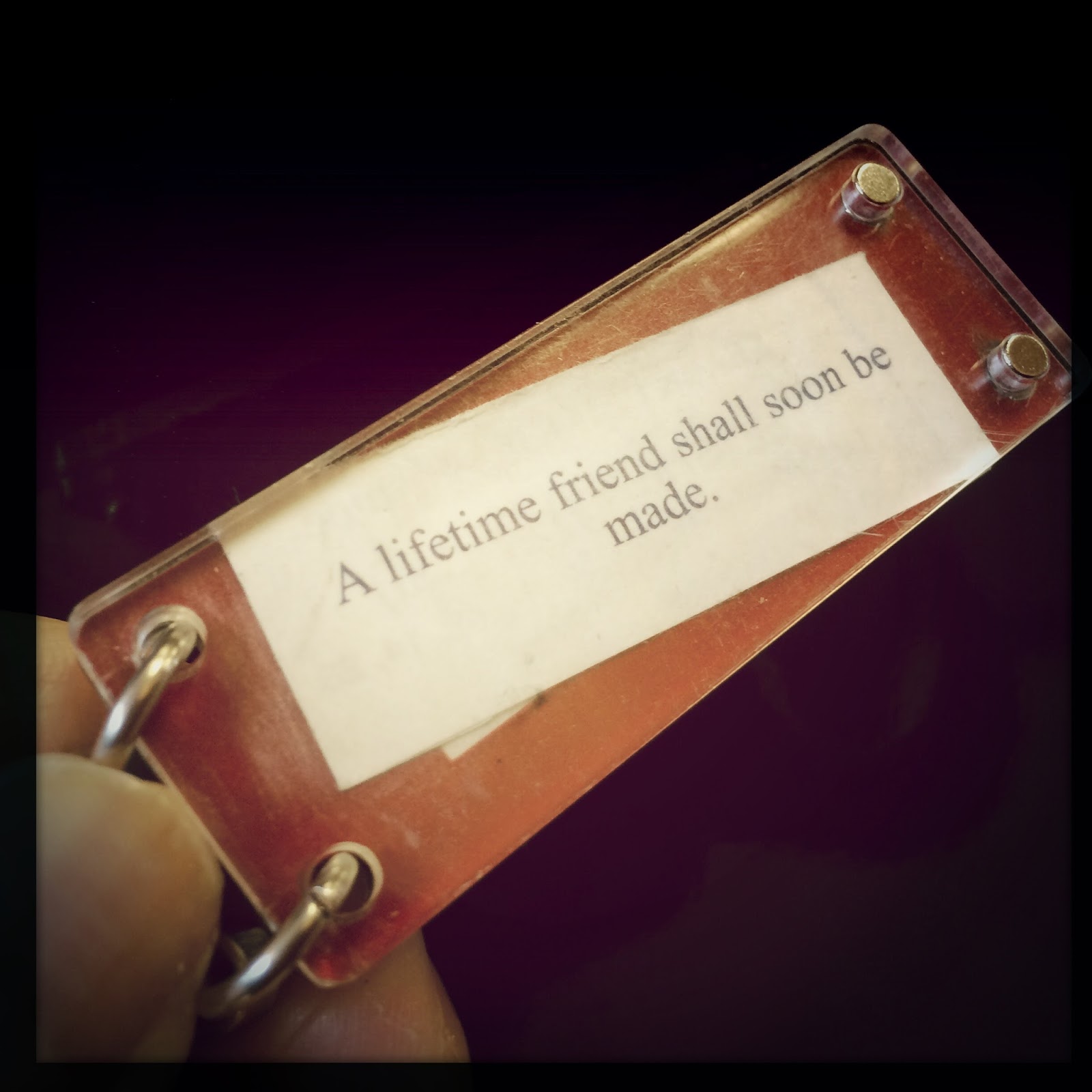
Just before leaving, I opened a fortune cookie to find this:


My friends rejoiced. “See! This will be a fabulous trip!” 

My expectations were scattered. In my mind, I worked through all the permutations. Who I might find or not. Who might want to see me or not. Who might look like me or not. 

I worried about my birth family, my adoptive family and my children. This trip would change me. I knew it. My family knew it. We were all anxious.

But once my feet hit the ground in Incheon, I felt the unspoken comfort of home. Like a long lost relative, John from G.O.A.’L, texted me as I moved through immigration and customs.

I was met with several happy, tired faces. Some spoke English, others Dutch and one French, but our faces were familiar. The next ten days brought personal disappointment and road blocks, wonderful food, many late night conversations at the BOA Guesthouse and a road trip to Gyeongju.

Before I knew it, our time was up. At the end of my journey, I wrote this:

“The plane takes off and tears are streaming from my eyes to streak my cheeks. I close my eyes in hopes of blinding the thoughts and images from the past ten days. The friends are so super special — my new family. ”

I had selected a beautiful handmade paper for my family room from a well-known calligrapher in Insadong. It was carefully rolled and stayed with me but would not fit in my suitcase. In my absent-minded fog, I left it on a counter outside security. Airport staff informed me that I could not retrieve it.

I was devastated. It seemed so silly to feel this way over two sheets of paper. I posted my sorrow on FaceBook. 

My new KAD family of lost brothers and sisters came to my rescue. Two women made it their mission to find the paper as they were checking in for their European flights. The news that they had found it reached me just as I was boarding. Relief and joy overtook me. Not many people would risk delaying a flight to search for two sheets of paper, but these were no ordinary friends. They knew that my attachment to those two sheets of paper was not trivial.

All my life, I was told that I was “chosen,” and yet, I felt out of control. This time, I was surrounded by people who knew my fears firsthand. I had chosen them as family, and they brought great peace to me.


I miss my adoptee family, but now, I am embarking on a new search where the circle of family will widen. Check out this short film by Bryan Tucker, videographer from Closure, that introduces a new book by adult adoptees for teen adoptees and fostered youth. Dear Wonderful You, adoptees are your village.


02 March 2014

What sucks about being adopted?

Here I go, down to the depths.

But before I take you there, I want to tell you that it isn’t that I am unhappy with my adoptive family. I am not angry at them or as some might say, “ungrateful.” Far from it. You can read about my mother, my father, my sister and my extended adoptive family in past blogs to understand the extent of our love.


Now, I want to tell you what sucks about being adopted.
  1. I have no birth certificate. —This frustrates me to no end. Every time, I needed proof of my birth, I had to dig out my naturalization papers (from age 5) and my adoption papers (from age 13 months). Well, that is not proof of my birth. Neither list my birth family or birthdate. This leads me to number 2.
  2. I have no true birthdate. — Yes, I have one, but it isn’t my true birthdate. It’s an estimate, a fabricated birthdate based on how I appeared on May, 24, 1968. 
  3. I have no birth story. — This never really bothered me until I had children of my own and realized how elemental it was to celebrate that moment when you take your first breath. I love telling my children’s birth stories, and they love hearing them. It bonds us all as a family because we were there at the creation of our family.
  4. I have no medical history. — This one is a true pain in my rump. With every move or change of health insurance, we must have that initial first meeting with the new doctor. It goes, “Any history of heart disease?” There, I stop them, “No history, I’m adopted.” This happens for me and my children, because obviously, the mother’s family medical history plays into the children’s health.
  5. I am not really Korean. — This one is complicated, and I have written about it numerous times. While my dad fed me kimchi, and my mother sewed hanbok sets for me, I really wasn’t exposed to the Korean culture in the way I would have been had I grown up in a Korean household. So, I find it irritating when I am viewed as Korean, spoken to in Korean, asked about my “real” Korean family, asked if I know Tae Kwondo … well, you get the picture.
  6. Reading or hearing the phrase, “like you’re adopted” (insert snarky, teen voice) — Language. Why must people joke with the word “adopted”? Listen, it isn’t funny, and I don’t appreciate being the butt of a joke. I am #notyourbadword. Adoptees are people with feelings, so refrain from using that word in jokes. Got it?
  7. Being referred to as an “adopted child/children” — Even as we grow into adults, we are referred to as “children.” This is especially prevalent in the media’s headlines and news stories. Someone please add this to the AP Stylebook!
  8. Being left out of the adoption conversation — Big one related to number 7. As adult adoptees, this perception of us as children seems to exclude us from the adoption dialogue. The fear that we might say or write words that might hurt adoptive parents is insulting. If an adoptive parent is hurt by the words of an adult adoptee, that parent is a grown up, remember? Adults should have the maturity to take someone else’s words, understand them and learn from them. 
Now that I have all that off my chest, carry on believing what you want of me, but understand that it might be an assumption by you, dear reader, given your history with adoption. Realize that every adoptee is different, has a unique narrative, and struggles with her own demons.

04 October 2013

Motherhood … a job well done?

At thirteen, I sank into depression. I became a person no one would recognize today, and I wrote my mother letters that said, “I wish you had never adopted me.” Those words wounded her.

I wouldn’t understand or remember the wounds until the week after her death. Going through her things, my sister and I found one of my teenage-angst-ridden letters. This was the only negative letter amongst every letter I had ever written her, a drawer full of letters from my days in college to our days in Rwanda. Our last joyous days before I became a parent were also there captured in this photograph from her visit in 1998.


All my teenage anger is now coming to the surface as I have my own thirteen-year-old. He’s struggling with himself, and often his words cut me just as mine cut my mother some 33 years ago. 

I am thankful for the friends who have supported me, but at times, it is hard. More seasoned parents will recall their troubles and say, “My mom was such a rock,” or “My mother was there to support me and show me the way.” Most do not know my personal struggles with the loss of my mother. I politely say “Thanks.” It is nice for those mothers and grandmothers to have that final realization that their job was done well in the end.

I wrestle with that. My mother didn’t have that realization, but I know she would have relished it. I am still on that rough road to finding the end … well-done.


21 July 2013

Geez! You must be “adopted” …

This blog post has been housed in my head since I heard This American Life’s Episode 498 a few weeks ago. You can listen here.

On our way up to the Korean culture camp on July 4th, I took the opportunity (long car journey) to catch up on my listening. My husband and I were seated in the front seat, listening.

Act Two, The Gun Thing You’re Not Supposed to Do, began playing. A woman from Texas told the story of how her family prided themselves on their responsibility in teaching gun safety to the children. However, this woman, after the Newtown shootings, revealed to her family that she had, as a teen, secretly used the handgun hidden in her parents’ dresser, and narrowly missed shooting herself.

The father and mother were devastated but changed their behavior by locking up their guns. However, her brother, Matt, (at minute 45:59) said, “I kept callin’ her how stupid she was! That she must have been adopted!!”

At these words, I sucked in my breath. My husband looked, wide-eyed, at me. We both glanced to the backseat, but both kids were busy and distracted.

The brother continued to talk about how his sister asked him if it changed the way he would handle gun education with his children.  At this point, the host, Ira Glass responded, “So your plan is when you have kids, they’re not going to be idiots like your sister.”

The brother answered definitively, “Right.”

Ira Glass then said, “You know I’m making a joke here, right?”

That joke and the comments were not funny to me. I wanted desperately to stop the car and write it all down. Luckily, I was not able to do so because my post would have shown my initial anger.

I like to think that I am not an angry person, but the misuse of the word “adopted” upset me. It hurt. Being adopted does not make you immediately “stupid” or an “idiot,” but hearing those words in the same conversation, in jest or not, does not help. I have the utmost respect for Ira Glass and listen to him every week, but his attempt at irony was lost on the brother, on me and who knows what countless others.

This misuse of the word, “adopted” happens everyday. The Twitter page, @AdoptionHonesty, is documenting all uses of the word “adoption” and its derivatives.


In the last post, I spoke about my calculated and careful writing when I write about race. But in actuality, I am mindful when I write every post.

My goal in writing this blog began in 2007 as a way to record my feelings on my adoption, my race and my life for my children and their children. It would be my way of creating a family history that wasn’t oral, but concrete.

As I transitioned from a private life blog to a more public presence, parents and grandparents began contacting me and writing me. They wanted to hear my stories.

Since meeting other transracial adoptees and learning more online, I have heard many angry stories. I fear that anger only shuts down a conversation.

To keep the conversation going, I can merely give my personal story and impressions. Hopefully, these stories will become threads in the fabric of families and the quilt of adoption.


09 May 2013

Mother Made

Rows of fresh orchids in plastic shells lined the shelves of the White Way Five and Dime. We picked each up and examined it. We were looking for the perfect red one …

Red symbolized life, and white for death. On Mother’s Day Sunday, we chose our best dresses and proudly wore the red orchids. A simple flower meant immeasurable, unconditional love. That same Sunday, we would take my mother and her mother, my grandmother, out of eat at a sit-down restaurant. This was a treat for everyone as we usually gathered at my grandmother’s on Sundays for lunch. Mother’s Day also included a visit to my grandmother’s mother’s gravesite.

My mother also saved the handmade cards we made as children for her. No Hallmark would do.


Today, I despise the lead up to Mother’s Day.  I get confused and angered by the numerous commercials that urge us to buy, buy, buy to show our love for our mothers. I’m angry in that my mother is not around to see me proudly wear a red flower or to share a special dinner with her grandchildren.

My last visit with my mother before her stroke, she had flown to Colorado to visit me in November of 1998. With her, she brought Kerr jars of canned green beans (immediately and proudly displayed over the window in the Thanksgiving photograph below). Proudly, she said, “I learned to can green beans on my own! I really wish I had learned from your grandmother, though.” It was times like this that my mother would get somber. Her last memory would crop up.


“You know, the worst thing I remember?” she would start, “I was cleaning up Mama’s kitchen, and I opened the Crisco. There inside, I found her finger marks.”

I imagine them today. Deep crevices in the Crisco. Grandma used her hands when she cooked. She didn’t have all the special gadgets that we have today. She didn’t measure but learned from her mother that biscuits took “about this much.”


So today, I celebrate the beans. The last jar has moved with me from Colorado to Maryland to Virginia and now, Wisconsin. I doubt I will ever open them. They represent the love and the loss.

I never learned how to can, but I plan to try canning tomatoes this summer. (My mother did learn the art of canning tomatoes from her mother, but I did not learn from her.) Repeated mistakes.

I can make her pinto beans and ham hocks, and her cornbread.  Again, no fancy measuring devices. Just eye-balling it.


I do enjoy the quiet time in bed with my own children as we cuddle on Mother’s Day. Our tradition is a breakfast in bed, and I love that.


If you could wear that red flower on Sunday, I encourage you to learn from her, and I plan to teach my daughter the art of mothermade.

30 April 2013

Come on, Hollywood.

This weekend, my son asked to watch The Avengers.  I enjoyed the quick wit of Iron Man and the strength of the Black Widow.

What I didn’t appreciate was this scene:


Thor’s use of adoption as an excuse to distance himself from his brother left me feeling sick and hurt.

Come on, Hollywood. Be more responsible.

25 April 2013

The Spectrum of Somewhere Between

Looking for an adoption film? Look no further.


While some may read my blog and believe that I am lost, or found, or searching, I direct them to an adoptee in this film, Jenna Cook. She says it so eloquently:

“All of us, this whole adoption community, we have this commonality about us, this unity. But at the same time, we each are at our own place, in our own journey. It’s a journey of our past, and we each have our own road and our own paths set out for us.”

This film, by far, is the one adoptive parents, children and families should see. The director, Linda Goldstein Knowlton, has found four teens that have four different stories. Each is happy in her adoptive family, and each searches for identity. Knowlton, an adoptive parent, has brought this film to fruition for her young daughter, Ruby.

Someday, when her daughter becomes that insecure teen, she will take comfort in the testaments of these four young women, Fang Jenni Lee, Jenna Cook, Ann Boccuti and Haley Butler. I longed for this sense of belonging as I write here.

In the last six months, I have awakened. My adoption sensitivities are keener. I am thankful and rejoice in being a part of this large community of adoptees.

Knowlton continues to post videos that reinforce the feelings I have had for many years, yet suppressed in my loneliness. I see hope in the future for other young adoptees, and Lili Johnson, one of the first Chinese adoptees, gives me hope when she says,

“As an adoptee, I have no ambition to seek resolution. I am not looking to make sense of myself. I’m not looking to have a right answer or a wrong answer. … I’m not looking for like diagrams or any like pictures of what being adopted is, what it means, what people should do, what’s the right way, what’s the wrong way because there isn’t one.”

Hear the call that asks you to think of adoptees with varying degrees of feelings and experiences. Think of us as your neighbors, your friends, your classmates, or simply the person you pass on the street. Just like you, we have our families, our stories, our varied backgrounds. Rather than separate us as different or odd, celebrate us as interesting.

Johnson also says it so very well:

“I get confused thinking about, you know, is being different good? Should we emphasize difference? … Or should we say ‘You’re American just like everyone else.’”


You can see Lili’s full interview here:

Lili at NYU from Linda Knowlton on Vimeo.


28 January 2013

The Road Taken

The film, Adopted, was loaned to me to start me on a journey …


The problem is, I don’t want the angry journey portrayed in this movie through the adult adoptee, Jennifer. I am not her, nor do I feel as she does. I have never felt abandoned.

I identify more with her adoptive mother who says, “I think I probably remember a lot more details about picking Jenny up from the airport than I do about giving birth to Eric.”

Yet in search of her “core validation,” this young woman continues to lash out at her parents through snide comments and hurtful rejection. She forces a journey on her parents that they have made and are ending. Both her mother and father are dying of cancer.

I understand her recollections of racism outside of the home; I lived through those same racial jokes (see examples in this post). Unlike her, I experienced these moments with my family. When children chanted racial insults, my mother rushed up and confronted them. She faced their hurtful words as they shouted, “Come get us you big, fat hippopotamus!”

From day one, we all were a part of the journey. My mother was my best friend. I shared all the hurt with her. We talked through it. The adoptee, Jennifer, did not share, and now all the pent-up 9-year-old anger has surfaced in a thirty-something young woman.

She talks of “being authentic and real,” but I pose that your reality is what you make of it. I pose that individuals are different. While every adoption story does not end like Jennifer’s or mine, there are varying degrees of acceptance, abandonment and unconditional love.

The adoption story isn’t just about the well-being of the adoptee, as Jennifer would like us to believe. If it is, in fact, as Jennifer wishes, a journey they all take together, there should be some sensitivity for the adoptive parent.

Recently I have spoken of starting an adoptee’s journey, but more precisely, it is just a new chapter in my life … one of sharing parallel experiences, laughing at similarities (like all the vacuuming and couponing), and learning new stories.

I appreciate the different stories, but my life is full of wonderful things.

My daughter recently summed it up, saying, “If you weren’t adopted, I wouldn’t be here and we wouldn’t be with Daddy.”

I am content with the road I have taken.

13 January 2013

Undercover Adoptee

Yesterday morning at breakfast, I heard this Story Corps taping (before you continue, you might want to listen). 

This dialogue between a mother and daughter will surprise you when you reach the end. In less than three minutes we discover the mother was adopted but did not discover this until adulthood.

This 2012 was a year of discovery in my adoption story, but mine focused on the discovery of other adoptees. 

Up until this year, I wandered around believing that I was quite alone and undercover. Every now and then, my secret identity would need verification through statements like, “I have no medical family history because I’m adopted.” and “Well, that isn’t really my birthday, it was given to me by the Korean government.”  

As I have mentioned, my life has been recently touched by three Korean adoptees. In a couple of instances, the adoptee knew immediately upon meeting me face to face that I must be adopted … few Koreans have a full Puerto Rican name.

Over the holidays, I had a cookie exchange. While introducing people, a new friend, Amy. (not to be confused with Amy in this post), asked how Miya and I knew one another. We mentioned that our adoption histories were similar.  At this, Amy said with a smile, “I’m adopted too!”

Amy is a caucasian woman with blonde hair. Her identity as an adoptee is not written on her face, nor does her name give any indication that she is adopted. Amy, Miya and I started sharing our common frustrations with routine questions like “Do you have any diseases in your family history?”

Like me, Amy lost her adoptive mother too soon. Like me, Amy has a younger sibling who is not only six years younger than her, but the sibling is also the biological child of her adoptive parents. 

Unlike me, Amy lost her father to cancer and had a middle brother who was also adopted. She had a sibling with whom she could confide as well as share her adoption questions as they became older. 

Amy is an art teacher. It is our love of art education that brought us together. When she began teaching, she spoke with her adopted brother about her fear that any of the children she was teaching could, in fact, be biologically related to her. Being so close to her birthplace and much like the adoption story in Story Corps, there was the possibility that those whose social circles intersected hers could be biologically related to her. Her brother assured her that she would be a fabulous teacher regardless of the background of her students.

Amy shares the deep love of her adoptive family that I do, but now I see another side of adoption. Those adoptions that are not international pose completely different questions and challenges. When you aren’t racially different from your family, you are undercover. My race has helped me find others like me, albeit some 40 years into my life, but for Amy and the woman in the Story Corps article, no one assumes that they are adopted.

This year has brought me rich relationships with people who share my adoption experience. I am truly grateful for these friendships. While we are all adopted, each of our stories varies and flows in differing ways, but we all can relate to one another in a way that others cannot. With one another, we are no longer undercover.


07 November 2012

Separate But Same

Today, as I sat waiting, I combed through my coupon organizer, a blue plastic expandable folder. Miya and I had arranged to meet. She arrived and upon seeing me, produced an almost identical blue plastic folder. Eerie, right?

Our childhood photographs look very similar as well, despite the fact that she grew up in New York state and I, in Tennessee. Little square Polaroids of each of us playing with our siblings in our adoptive families.

We have been comparing our baby albums and our adoption letters and papers. Having seen her adoption paper cover, signed by one John W. Bligh, Jr., I remarked at how similar it was to mine. Of course all this was from memory.

Last week, I invited her husband and her children to our home so that the families could finally meet. My boy took her boy and wandered to his room. My girl took her girl and disappeared into her room. The men sat on the sofa and chatted.

Miya and I began looking at our legal adoption papers, side by side. I presented the thin tissue paper packet that sealed my adoption.  On the top was my Certificate of Acknowledgement, signed by the same John W. Bligh, Jr., the Vice Consul of the United States. “Strange,” we remarked.

Then, the date … my paper was signed on the 6th of December 1968, and hers was signed on the 9th of December 1968.

Two girls adopted in the same week in Seoul now sat as women, reunited by all of our commonalities.


01 November 2012

Who are you?

Today, at my dental check-up I was surprised that my hygienist had changed. My name was called by a young Asian woman with highlights like mine.

As we walked back, we made casual exchanges, and I asked her where she had her hair colored. (Since moving to Wisconsin, I have yet to find a stylist to color my hair as I like it.) She obliged with a name. She noticed and asked about my accent. I commented that hers wasn’t the typical Wisconsin accent.

She also continued to tell me a bit more about herself … her background living in Massachusetts and Long Island, then moving to Wisconsin as a sophomore in high school. After a very pleasant visit, I got up to leave.

As I put on my coat, she suddenly mentioned that she was Korean and adopted! I let her know that I, too, was adopted and Korean. This prompted her to reveal even more.

She was adopted in the 1980s at one-and-a-half years of age with her biological sister, who was three at the time. Their birth mother had died of cancer, and her father could not care for them. They were moved several times to different homes, her aunt’s, a parish, and finally the orphanage. Adopted by a family that had two natural sons but wanted two daughters, she spoke of her childhood in a Caucasian community.

Recently, a letter had arrived for her and her sister. It stated that there had been a “development” in her and her sister’s adoption case. While she said she was curious and ambivalent, she said she was allowing her sister to take the lead on it. She revealed her sister’s sense of abandonment growing up and her struggles with their adoption and heritage.

I explained how her differences with her sister mirrored mine with my adoptee friend. I mentioned that I consider myself American first, while my contemporary adoptee friend, Miya, sees herself as Korean. This young woman said she felt the only thing she kept of her ethnicity was her love for kimchee, a pickled Korean cabbage. “I eat it every day!!” she said.

Like this young woman, I don’t feel those feelings of abandonment. That will need to be the subject of another post. After the visit, I went to my car and called Miya. In the past, I would have called my husband, but she does feel like family now.

“I’ve spent my entire life explaining who I am,” I said to Miya. “Now, I don’t have to explain. She just recognized me as adopted!”

Miya replied, “You’re still in your adoptive infancy, and I can’t wait to see you grow.”