Showing posts with label mother. Show all posts

19 November 2016

Setting aside my whitish ways …

When I was a white, I talked like a white,
I thought like a white,
I reasoned like a white.

When I became Korean,
I set aside my whitish ways.

When I was a white,
I was “chosen.”

When I became Korean,
I was lost.

When I was a white,
I mourned my mother at her gravesite.

When I became Korean,
I mourned a mother in Korea.

When I was white,
I called myself, “Oriental.”

When I became Korean,
I called myself “Asian.”

When I was white,
I used the word, “Caucasian.”

When I became Korean,
I used the word, “white.”

When I was white,
I rejected the Asian men who loved me,
calling them affectionately, “brothers.”

When I became Korean,
I realized that the men I loved
were always white.

When I was white,
I dated white men.

When I was Korean,
I realized the implicit privilege
I had from my white partners.

When I was white,
I dated a white, Wisconsin-born GI.

When I was Korean,
I realized he never loved me.

When I was white,
I married a British man.

When I was Korean,
I realized he loved me.


28 February 2016

Korea: I’m shattered.

Dated January 23, 2016, on flight KE037 …

I am fragments.
The First maternal fragment,
Is my flesh and blood —
A round ass, dark hair —
Slant eyes.

I imagine her now as an “Ajumma”
Peeling chestnuts for sale in the streets
Of Cheongnyangni in Seoul.

The Second recorded my firsts.
Steps, words and that crucial first birthday.
She was a photography professor’s wife.
I was attached to her, they said.
But that is all I’m allowed to know.

The Third called me hers.
She was love wrapped
In the sweet smell of perfume.
She believed I would grow
To bear a red-headed child —
With the auburn curls of her youth.

She took insults like
“Big Fat Hippopotamus”
As she rescued me
From my third grade racist tormentors.

She would lay a dark chocolate almond bar
On my pillow in anticipation
Of her college girl’s return.

When it came my time to be mother,
I realized my flaws.
I felt my first’s tiny hand trace mine
Through my hot, stretched belly bump.

I shut my eyes,
Imagining my small hand doing the same
In Post Korean War Seoul.

And here I realized the significance of my First
Somewhat forgotten
Pushed to the recesses of my mind —
Mom, Omma.

Just as the Third watched this new
“Oriental” baby reach a stage she knew …
She was gone.

I was left to ponder.
Wonder again what it was like to be mother,
Without the guidance of another.

In my son’s development,
I noticed the crucial stages left to my imagination.
Solids at six months —
A time when my breastmilk could no longer
Keep up with a growing child’s insatiable appetite.

I have an insatiable appetite.
Did I need too much?
I was left at six months …
Somewhere …
A police station?
Yes, of course. Like all the others.

Let the records show —
But not too much.
They cannot.
They are hidden, trashed,
lost in the shame of a country that sent me away.

That shame is mine.
I rejected Korea for so long.
My son’s questions prompting more.
Our five-month stay was a gift.
A hope to show them their country.

But I realize it is no longer mine,
And they cannot claim it.
We are 미국 … American.

What mother takes her children
To a place she says they belong,
While she uses silence to blend in?

In crowds, they panic when they cannot find her.
She is not yellow in a sea of white like home.
What wrong is she trying to right?
What mother fragments her children?
I do.

10 May 2015

My anger protects my pain.

I dread today. That sounds selfish and unkind … especially to those this day is made for …

… those with intact families,
… those who have not lost children,
… those who have not lost mothers,
… those who profit from the expression of love through material items.

I sound bitter and angry. I am.

I have repeated this many times … my anger protects my pain.


As I watched my social media flood with photographs of those who look just like their mothers, it pained me for they have their mother’s eyes, her nose, her lips, her skin-coloring and her hands. They have a physical reference.

Here is where I hate myself. I hate that I feel this way. Here is the person adoption proponents and agencies hold up to say, “See? Look how ungrateful she is. She was loved to such a degree. She was saved from the throes of poverty and woe in Korea as a child of a single mother.”

And yet, what they chose to ignore is that on any other day, I relish the joy of seeing people smile in the comfort of Mom, but on Mother’s Day, I envy it. I want it.

I had it … once … twice and now. I had six months with my mother, seven with my foster mother and Mom’s entire shared lifetime. But those moments of motherhood are now fleeting memories, relegated to the frozen moments in time that film could capture or the moment that only my cellular tissue could memorize.

Luckily for me today, my first read of the day was a post from a new friend, April Dinwoodie of The Donaldson Adoption Institute. I met her at the American Adoption Conference, and we became fast friends. The image below shows Angela Tucker, Kat Nielsen, Dinwoodie and me breakfast fresh!


I could quote Dinwoodie’s entire post, but that wouldn’t do her words justice. You must take the time and read it all. She brought me back … to sanity. She reminded me of focus and purpose.

A little anger doesn’t harm if the intention behind it is well-meaning, right? My purpose is to help the children of adoption sort out their feelings. My purpose is to bring validation to those feelings because it’s okay to own your feelings. They are your feelings, your narrative, your life.

It’s okay to consult qualified professionals (social workers, therapists, psychologists) and allow them to help you sort it out. It’s okay to long for something you just cannot put your finger on.

I longed for the beauty of seeing myself reflected in someone. Today, I have that. My own family is my start from scratch, now that my adoptive parents are deceased. My children are my joy. We share DNA and the longing to be loved. We share the sorrow of loss and the shortcomings of adoption.

My day ended with this beautiful recital piece by my daughter. As she played and a few others too (including a few adoptees), I let the tears fall. Music has always moved me, and these young musicians brought me peace on a day that had also brought me pain.


15 November 2014

The Day of Loss

I asked my husband and kids this year to pick a day in November to surprise me with birthday wishes. They have been so supportive, despite their confusion. My daughter anxiously looks at the small pile of pressies on the dining room table and says, “When are you opening these?” I love the anticipation and excitement in her eyes.


Her youthful joy reminds me of mine at her age. My mom created this joy for me as a child. My fondest memories of my birthday were of those childhood days filled with homemade cakes and crepe paper. (Note: From now on, my adoptive mother will be referred to as “mom” and my birth mother will be referenced as my “mother.”)

Those days are gone. The mom I loved is gone. The mother I lost is not found.

I tried. I did. I tried to find my mother and my foster mother this year.

Today is such a lie to me. This date is only given to me, and not knowing the true date hurts.

I remember my children’s birth stories, and I remember my miscarriage in 2002. (That loss happened around this day of my government-issued birthdate.) Each of those stories makes me the person I am today. I am left to only imagine how special my birth day was to my mother.

My mother and I are separated. Time, the Korean government, the agencies, the Korean culture separate us. I cannot even hold on to a date to think, “I wonder if she thinks of me.” When she thinks of me, I may not simultaneously look to the sky and say, “나는 당신을 사랑합니다.”

And that brings me great sadness.

For this month of November, please consider sharing an adoptee’s story. (There are so many wonderful voices to share.) See some of my favorites below. If you share on social media, consider tagging your post with #flipthescript on #NationalAdoptionMonth.

Amanda, Karen, Julie, Angela, Rebecca

And of course, The Lost Daughters!

29 October 2014

Parenting? Well, that’s a pain-filled one.

My daughter, like myself at her age, says she will never bear children. Her reasonings are based in physical pain. She cannot imagine a child exiting her vagina. My reasonings were far more complex, and as a teenager, I selfishly wanted a life without responsibilities that children brought.

Parents of all kinds kept repeating the “You’ll never know the joys of parenthood until you are actually a parent.” My husband and I would just roll our eyes; we were DINKYs (Double Income No Kids Yet & livin’ the good life). That is, we thought it was the good life, until going out to dinner every night and drinking with friends became unfulfilling.

The moment I realized what that blue line meant, I was frightened and excited all at once! Could I do it? Could I be a good parent?

The minute my first child emerged, bloody and crying, I knew I was meant for this. I was connected despite that umbilical cord being severed. I tried to ask my mother about parenting a little boy. She kept saying, “Well, I just had girls. But just love them.” Six weeks after my firstborn’s birth, she had a stroke. The minute her eyes laid sight on him, they twinkled. The ICU nurses said she physically and mentally perked up. He was our little light in all the sadness of my mother’s illness.

After her death, I felt lost. Lost because I was a mother without a mother. At first, I thought that her death was the only thing I could relive and understand my loss. I replayed it over and over and over again.

But then, the penny dropped. This year, the first and primal loss surfaced. This year, I realized the first loss … my birth mother, my original mother, my natural mother. Like my connection to my own children, I understood that like Philomena Lee, my mother may have felt the loss I was feeling … that we might be connected by the same spiritual umbilical cord that keeps me connected to my children.

My son is a teenager now. His fears and anxiety are real, but sometimes, they get the better part of him. When that happens, his fear wounds me in a way I am not sure all mothers know.

You see, recently, I had no control over his safety. I was forced to leave him in a place where he was distraught and scared. I wanted to help. I wanted to stay, but the powers that be, made me leave him.

When I walked out of his hospital room, I felt the pain that I imagined my birth mother felt as she left me. I will not know how she left me, but the many ways play out in my head EVERY. DAY. Was her leaving me out of her control? Was I taken from her? Was she powerless?

I never thought that I could be powerless as a mother, as a parent, but my son’s recent trips to hospitals have illustrated that I cannot always control the safety of my children. That frightens me and pains me. I am wounded every time my son tells strangers that he is afraid of me. (He explains to me that he is not physically afraid of me, but he is afraid of the truths of life that I try to explain to him … like his need to go to school … how life isn’t always fair.) I am fearful that others will take my children from me in misunderstandings and just plain recklessness of systems that do not care to know those involved.

All this reminds me that my circumstance as an adopted person … as an adoptee was completely beyond my control and possibly my birthparents’ control. If I cannot keep my children safe, how can I expect that my birth mother could?

I have not told my son the workings of my pain. I never want him to feel the guilt that I feel today … the guilt that I may have caused my mother to face ridicule … the guilt that I may have caused my mother pain in the separation … the guilt that I feel my mother may feel to this day because I am simply not with her.

I feel ripped up, torn, tossed away and salvaged. I spend my time these days in the pottery studio. Recently, I created the belly bowl. It represents all the birth mothers who feel that the adoptees have been torn from their lives.

The beauty of it is its contents. Adoptee pendants. I will stop using the word “adopted” to describe me or my series. From now on, I want to own the title “adoptee” for it represents secret pain, strength, perseverance and purely who I am.


03 October 2014

Korean Kin, Part 2

Sadness. Overwhelming sadness is the only way I can describe how I feel about learning nothing new about my history before my adoption. I lost my adoptive mother in 2001, I lost my biological family in 1968, and I lost them again this year.

Loss seems to be a pervasive thing in my life. I accept that. The biggest blows in my life have been the loss of the women … my mother, my Grandma in Tennessee and my Abuelita in Puerto Rico. Losing them was like losing my compass. However, now, I understand the loss more. I knew loss long before I lost them.

Before these mothers, I had an original one. I know nothing about her except that she cared well for me until I was six months old. After I lost her, I found another woman, my foster mother, who would love me and build a bond with me. But then, I lost her too.


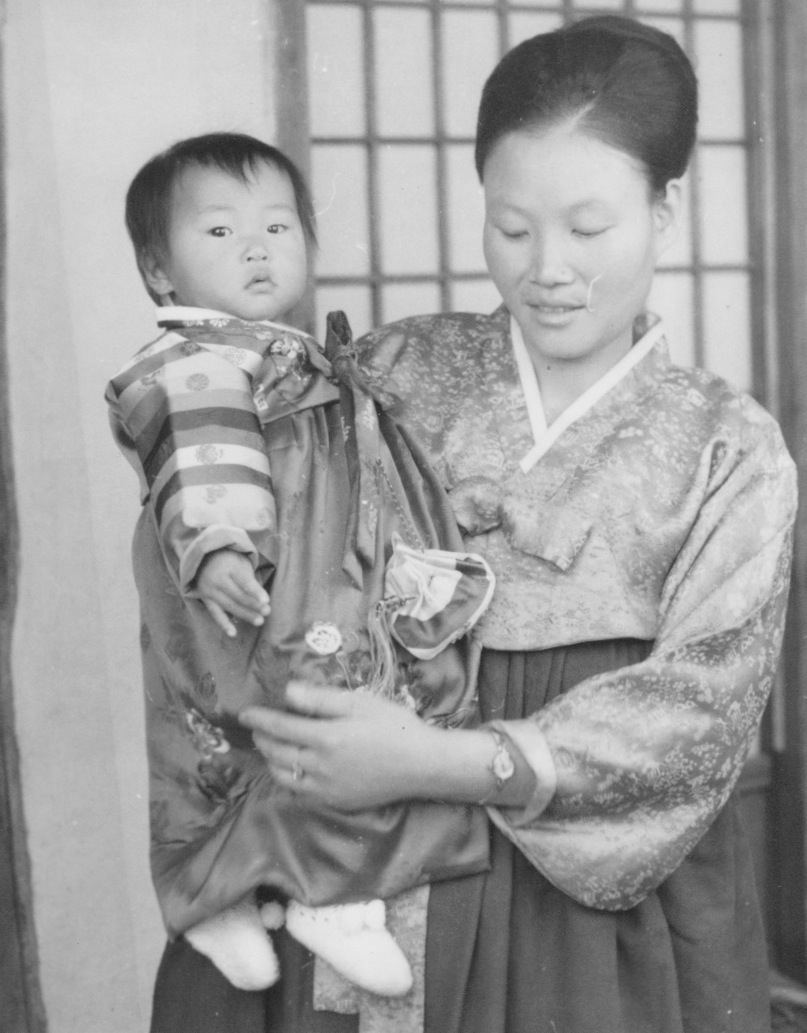
I had hoped that my interview with the Korean news agency, SBS, would allow me to find this second mother. But alas, that would not be. The only clues I was given came from the adoption agency social worker. She seemed surprised that I owned photographs of my foster mother. “In those days, only the wealthy could afford photographs such as these taken at home.” I have stared at these images since early childhood. They were sent to my parents after my first birthday by the adoption agency, but today, the agency has no record of who they are. I hold on to these words from my papers:

“Is attached to her foster mother, and not shy of strangers. …” — Progress Report dated August 23, 1968. 
“Sook Hyun is a happy and healthy girl, who enjoys a normal progress. When she came at first, she had a little herdship [sic] adjusting herself, but now she is a different girl, who is always cheerful and in good shape. She is loved a lot by her foster family and is expected to be a nice addition to her would-be adoptive parents.” — Progress Report dated December 11, 1968.
A piece of me remains in Korea, in the corners of my foster mother’s mind.

The moment my feet hit Korean soil, I felt at home. Comfortable and reassured. Included and content. No more wondering how I would cope with Korea.

If you haven’t read Part 1, you can find it here. Stay tuned for Part 3 … the silver lining.

23 March 2014

Shame vs. Trauma

In my home state of Tennessee, a federal judge granted an injunction on the state’s gay marriage ban. It was a small victory in my eyes, and I gleefully posted an article by a local news agency on Facebook (FB). In my post, I asked out-of-state friends to read the comments so that they could understand the level of discrimination.

This brought a flurry of comments, utter disgust from non-Tennesseans, and confusion from Tennesseans. A cousin and two schoolmates felt I had misrepresented our hometown, where they still live.

My cousin was the most upset. She interpreted my comments as a sign that I was ashamed of my family and where I grew up. I understand her confusion. My days in my hometown seemed idyllic. I loved time with my family and did well in school. But there was trauma.

My mother knew it from my first day at the local elementary school. I was nine-years-old. The teacher had directed me to the lower parking lot where my mother was parked. My sister was little, so it was difficult for my mother to walk and meet me. As I walked down the hill, a group of children gathered around me. They encircled me and began chanting, “Me, Chinese. Me play joke. Me put pee-pee in your Coke!” All I remembered were large faces with eyes pulled to slants, laughing and looking down at me. I curled into a ball. 

Within seconds, my mother, toddler slung on one hip, rushed up and began screaming at the kids. She wanted names, but they scattered and screamed back, “Come get us, you big, fat hippopotamus!”

My face was wet with tears, but my mother’s was red and hot. Her anger was frightening. 

From that moment, I wanted to protect her. I kept my shame silent. Shame was knowing my family and I faced discrimination because I was different. I wanted my family to be buffered from the hurt I would endure each day, as someone would pull their eyes or make a ching-chong reference. 


So, I must admit, I was taken back by my cousin’s question of my shame. Was I ashamed of my hometown and family? No.

Traumatized by the racist comments? Traumatized by the marginalization? Traumatized by the hatred? Yes.

When I read the hate-filled comments on the recent same-sex marriage decision, it brought back the trauma of victimization. I felt the trauma of losing my friend, Patrick, to gay bashers. I felt the trauma of being discredited because of my Hispanic name. I felt the trauma of never being “normal” enough to date. 

Many do not believe this to be possible. The two classmates assured me that I would be surprised at the progress made in our small hometown. I agreed to go out with them when I returned for a visit to see it in action. But even today, I know Asian adoptees in Tennessee who suffer the same trauma I did. When you are white and local, it is difficult to see the hurt and hatred that lurks in the school bathroom or a nook in the library. I do not fault them for this blindness, but I do ask them for consideration and understanding that my lens was different from theirs.

While the conversation also meandered around a rural versus metropolitan theory, I just listened. Perhaps it may appear that racism and same-sex marriage discrimination occur primarily in rural areas, but if you are a person of color (POC) or a gay or trans person, you know differently. 

This is the year where my Twitter activism and my personal FB page have intertwined. With that, there will most likely be more discussions of race, gender, sexual orientation and adoption. My FB page will no longer be a celebration of a perfect life; instead, it will be a realistic view of my life. 

As adoption loyalty has fallen away, my shame will no longer be silenced.


02 March 2014

What sucks about being adopted?

Here I go, down to the depths.

But before I take you there, I want to tell you that it isn’t that I am unhappy with my adoptive family. I am not angry at them or as some might say, “ungrateful.” Far from it. You can read about my mother, my father, my sister and my extended adoptive family in past blogs to understand the extent of our love.


Now, I want to tell you what sucks about being adopted.
  1. I have no birth certificate. —This frustrates me to no end. Every time, I needed proof of my birth, I had to dig out my naturalization papers (from age 5) and my adoption papers (from age 13 months). Well, that is not proof of my birth. Neither list my birth family or birthdate. This leads me to number 2.
  2. I have no true birthdate. — Yes, I have one, but it isn’t my true birthdate. It’s an estimate, a fabricated birthdate based on how I appeared on May, 24, 1968. 
  3. I have no birth story. — This never really bothered me until I had children of my own and realized how elemental it was to celebrate that moment when you take your first breath. I love telling my children’s birth stories, and they love hearing them. It bonds us all as a family because we were there at the creation of our family.
  4. I have no medical history. — This one is a true pain in my rump. With every move or change of health insurance, we must have that initial first meeting with the new doctor. It goes, “Any history of heart disease?” There, I stop them, “No history, I’m adopted.” This happens for me and my children, because obviously, the mother’s family medical history plays into the children’s health.
  5. I am not really Korean. — This one is complicated, and I have written about it numerous times. While my dad fed me kimchi, and my mother sewed hanbok sets for me, I really wasn’t exposed to the Korean culture in the way I would have been had I grown up in a Korean household. So, I find it irritating when I am viewed as Korean, spoken to in Korean, asked about my “real” Korean family, asked if I know Tae Kwondo … well, you get the picture.
  6. Reading or hearing the phrase, “like you’re adopted” (insert snarky, teen voice) — Language. Why must people joke with the word “adopted”? Listen, it isn’t funny, and I don’t appreciate being the butt of a joke. I am #notyourbadword. Adoptees are people with feelings, so refrain from using that word in jokes. Got it?
  7. Being referred to as an “adopted child/children” — Even as we grow into adults, we are referred to as “children.” This is especially prevalent in the media’s headlines and news stories. Someone please add this to the AP Stylebook!
  8. Being left out of the adoption conversation — Big one related to number 7. As adult adoptees, this perception of us as children seems to exclude us from the adoption dialogue. The fear that we might say or write words that might hurt adoptive parents is insulting. If an adoptive parent is hurt by the words of an adult adoptee, that parent is a grown up, remember? Adults should have the maturity to take someone else’s words, understand them and learn from them. 
Now that I have all that off my chest, carry on believing what you want of me, but understand that it might be an assumption by you, dear reader, given your history with adoption. Realize that every adoptee is different, has a unique narrative, and struggles with her own demons.

13 February 2014

Two Little Words

Yes, I let the anniversary of my mother’s death (February 2) pass without blogging.

The loss of my adoptive mother, the only one I call “mother” in this blog, was expected. She had had a stroke, been rehabilitated, but not offered the by-pass surgery she needed to survive the heart disease her family claimed as its own. But while we knew my mother’s days were numbered, the shock of her death came as a surprise, and I still suffer from it.

Since the beginning of my adoption, I had always been told the story my parents were told by the adoption agency. My parents never hid any letters or papers they had received; they were up front and honest. I knew that I had been found on May 24, 1968, that an investigation had uncovered nothing, and that I had been given a name and a birthdate.

This narrative is branded into my brain.

I have never owned a birth certificate. My proof of being is my US naturalization papers at age five and my Korean adoption papers at age 13 months. On them, my fake birthday and my fake Korean name are repeated numerous times.

So in the same vein as the moment I received the call about my mother’s death, I experienced a similar shock as I read through my US adoption file which arrived on January 29.

To add to my fake birthday and my fake Korean name were these two little words:

“No Record”

Reading them in black and white, shot pains throughout my body. It was as if every cell was devastated.


These words, “No Record,” repeated, over and over, on what is the equivalent of a birth certificate in Korea, the Ho Juk Deung Bon or Family Registration. It continued to say that my “family” of one (just me) was established on August 8, 1968, and that my name had been given to me on July 19. Interestingly enough, I wondered, “So, what did they call me between May 24 and July 19? Just #5596?

Some really poignant words in my progress reports:

“When she came at first, she had a little hardship adjusting herself, but now she is a different girl. … She is loved a lot by her foster family …and [has] a good relationship between her and her foster mother. … Is attached to her foster mother, [sic] and not shy of strangers.”

I am reminded of that frightened little one in this first photograph.


The “hardship”?!?! The pain I felt reading all these words. My body, my being, my soul were aching for my biological family. The sliver of hope for another family vaporized and vanished.

I am still looking, but in the meantime, a movie trailer has haunted me. (Trust me, I really hate putting this trailer here. If you have seen it, don’t grant it another view, please.)

"The Drop Box" - Documentary Trailer from Arbella Studios on Vimeo.


My daughter watched it with me. Her response? “The mom doesn’t identify herself because people would judge her.” This, from a ten-year-old. The simplest idea was seen by my daughter despite all the feel-good fluff in the movie.

In the trailer, a man says, “These children are helpless … voiceless. Who will speak for them?”

And I am screaming, “Me!! Let me!!”

Please arm yourself with the facts. I have researched them, and you can find them at the Lost Daughters website in the post, “I was the baby in the box.” If you would like to help adult adoptees in their search, consider donating to KoRoot on their site.


04 October 2013

Motherhood … a job well done?

At thirteen, I sank into depression. I became a person no one would recognize today, and I wrote my mother letters that said, “I wish you had never adopted me.” Those words wounded her.

I wouldn’t understand or remember the wounds until the week after her death. Going through her things, my sister and I found one of my teenage-angst-ridden letters. This was the only negative letter amongst every letter I had ever written her, a drawer full of letters from my days in college to our days in Rwanda. Our last joyous days before I became a parent were also there captured in this photograph from her visit in 1998.


All my teenage anger is now coming to the surface as I have my own thirteen-year-old. He’s struggling with himself, and often his words cut me just as mine cut my mother some 33 years ago. 

I am thankful for the friends who have supported me, but at times, it is hard. More seasoned parents will recall their troubles and say, “My mom was such a rock,” or “My mother was there to support me and show me the way.” Most do not know my personal struggles with the loss of my mother. I politely say “Thanks.” It is nice for those mothers and grandmothers to have that final realization that their job was done well in the end.

I wrestle with that. My mother didn’t have that realization, but I know she would have relished it. I am still on that rough road to finding the end … well-done.


05 September 2013

How Hands Define Us

In the summer of 1987, a few months after my grandmother died, my mother stood, shoulders slumped and shaking. The scent of biscuits had pulled me into the kitchen.

She was silently sobbing. I hugged her and asked what was troubling her.

“Oh, I just remembered something as I was making biscuits,” she said. I looked at her in that knowing way … asking her to continue without using words.

“Shortly after your grandmother died, I went to the kitchen to clean out things. When I opened the Crisco, I saw where she had used her fingers to take the Crisco out to make biscuits.”

I imagined the tracks made by my grandmother’s hands. She cooked without measuring, and most everything was homemade. I remember her hands.

As a teen, I would often sit down with my grandmother … clip, file and clean her nails. She had the sweetest hands, tired from years of working the land and feeding her family. I can remember them, but I regret never learning to draw well enough to reproduce them.  Ironically, I began my coursework in photography that following fall after her death.

It is those we love who define us. The best I can do now, is document the hands that define me. I began late, so I have no images of my mother’s hands either. They are imprinted in my mind as well.

So, I present one of my most intimate series of photographs.


The series began with this image I made of my daughter and my husband’s mother’s hands. My mother-in-law is the only grandmother my daughter has left.


This summer I traveled to Tennessee to capture the hands of my father as his wrapped around my daughter’s.


Then, I found the woman who served as a surrogate mother to me in my early years as a young professional.


Here are my daughter’s hands.


This has inspired my son to also document my hands. Here are mine wrapped around my daughter’s as we sat in a restaurant talking with friends.


But this is my favorite hands photograph, taken by my husband. This was the decisive moment where the love of my kids presents the definitive definition of me.

23 August 2013

My Cloak of Comfort

Yesterday, I heard a story of a woman similar to me.

This woman quit her job and moved away with her husband, who like mine, traveled a lot. In the past few years since the move, she found it more and more difficult to find employment in her new home base. So, she decided to move back to her old town and find employment. She was quickly hired but had to leave her child behind with her mother.

Hearing this story, filled me with envy. I felt selfish and resentful. I imagined myself moving back to Virginia and rejoining my former boss in our dynamic duo of design loveliness. This imagining quickly dissipated as the reality set in.

I love my children. I am fiercely protective of them. I cannot and will not relinquish their care. The other challenge in this overblown dream is that I no longer have my mother. My sister lives in Washington state, and my father lives in Tennessee. I have no one to come to my rescue if I were to decide to pursue such a dream.

We walked the halls of both of my children’s schools today. They were energized, but also reluctant. It was a bittersweet day. As the constant heavy rain fell, it seemed so apropos. We need it, but it still saddens us. 

Just as I felt helpless, my book of womenfolks beckoned me. As I sat in the parking lot, waiting for my son to finish soccer practice, I read this passage:

“Every Friday, Viola and Frances (my mother) started the morning at The Beauty Shop. Dorothy would wash, tease and spray the mothers’ heads. It took hours.

In that time, my sister and I would spin in the salon chairs, bask in the dry heat of the hair dryers and hear the latest gossip. We loved Fridays.

Afterwards, we crossed the street to the Belk department store to browse. Here, my sister and I would play in the circular racks. My mom bought my first training bra at Belk.

From there, we would make our way to the grocery store, White Store. At the end of the first aisle, there was a Coca-Cola machine.


For 25¢, we would get an ice-cold Coca-Cola in a glass bottle. After a few sips, my grandmother would slip me 10¢ to go next door to pick a candy from the 5 & Dime.

I always went for the huge sour apple lollipop. It woke my cola-cleansed tongue with a stinging sour.”
Recalling the sheer joy of those days, on a day like today, was like the womenfolk in my life wrapping themselves around me. They were telling me that the sadness I felt, the loss of self, wasn’t that at all. It was the beauty of life and being one of them.

30 June 2013

The Sisterhood

Summer brings sunshine, happiness (from the sunshine) and movies! This summer in the spirit of my daughter (aka #feminist9YO), I have vowed to see movies with female protagonists, or as she calls them, “movies with strong female characters.”

This week, it was The Heat.

*spoiler alert*

In it, Sandra Bullock’s FBI character reveals that she was a foster child and a young girl who had few friends. When this played on screen, I cringed. “Great, another Hollywood slap in the face for child welfare,” I thought. I had reported on the abuse adoption received in The Avengers here, and I braced myself.

However, this movie plays out quite differently. At the end of the movie, Melissa McCarthy’s character signs Bullock’s character’s old high school annual. When the audience was able to read it, her words took my breath away. In that moment, when McCarthy’s character refers to Bullock’s as her “sister,” I felt the acceptance that the character felt. My vitamin D-deprived psyche shed some negativity.

In the adoption/foster care world, we talk so much these days about loss … the loss of families, the loss of self, the loss of racial identity. I have cycled through this loss and am still circling back as my children cycle.

But this reminded me of the things that make me truly happy … relationships, and more specifically, my female relationships. The women in my life who have helped me through the loss, the hurt and the anger. My mother taught me the importance of friendships. Hers is the strongest I have ever known, and I model my friendships after hers.

My sister, while younger than me, has also enriched my life. I often find myself looking to her for guidance. She is my sounding board.

So many wonderful women have held me up and given me strength. I consider my “little sisters”: Jenny (my Frances Ha, another excellent movie), LaDawn, Nicole and Jessica. I cherish my relationship with Marlene, who I called my “other mother,” as she nurtured me when I began my life as an adult in the workforce.

There are my other sisters, Kathy and Kayla, and my twin sisters, Katherine and Adrienne, who have tutored me in all things Asian and helped me form my Feeling racial identity. They reassured me that my common childhood anxieties were theirs too.

All these women have cycled through my life, and while they are a big part of my life still, they live so very far from me. Our lives are so busy and finding the time to talk is a challenge. The Wisconsin winters and my move here lead me down a few dark paths, but now, another sister has entered.

This sister has a positive outlook. This sister has an appreciation of my feelings on adoption. This sister is also adopted. There is much to be learned from this next chapter of sisterhood. We all need a “sister.”


20 April 2013

Wish


If you can call your mother, do so.
20130420-105027.jpg
(From Real Simple magazine this month)

14 February 2013

Our Last Valentine’s Day

In 1993, my mother and I shared Valentine’s Day. Each of us would have been alone that Valentine’s Day, had we not had each other.

For me, that day was V-Day or VD. I celebrated it as a day to enjoy my independence from the vagaries of love [LUUUUUhV].

My mother saw it as a day to celebrate her role as a mother. Our 1993 Valentine’s Day was the last one we had before I found another love. She would always remember this day in the years to follow.

In those following Valentine’s Day phone calls she would say, “Remember our last Valentine’s Day alone?  We had drinks at Red Lobster and then moved on to the Spaghetti Warehouse. Remember?”

My response would be, “Yes, Mom.  I remember. You loved downtown Knoxville. It reminded you of your days as a single woman, right?”

“I loved that we were spending THAT night together,” she would reply with a little sadness in her voice.

In March of 1993, I found the man who insisted that he not complete me, but complement me. It was a whirlwind.

We dated and moved in together that following September, against my mother’s wishes. That Valentine’s Day in 1994 she would be despondent.

For my mother, I think she felt her love had been replaced. On outward appearances, yes. Deep inside though, I still loved my mother as strongly as I had that prior Valentine’s Day.

She would feel much better about this “replacement” when the man who had “taken” me “away from her” proposed in September of 1994. This became the point of healing.

She had a wedding to plan, but it was still extremely painful for her to let go of her first child. My mother was not shy about expressing her feelings … to me and my future husband.

I still see the mixture of pain and pride in her face in this photograph taken at our wedding (Image by Rob Heller).


Someday, I will feel this pain in the same way. But for now, I enjoy the valentines my children give me and remember that evening so long ago at the Spaghetti Warehouse in Knoxville’s Old City.

02 February 2013

Love is enough.

The subtitle for Barb Lee’s Adopted film is “When love is not enough …”.  What kind of love is she talking about here?

I argue that love is enough.

The love I know came in the form of handmade, Korean clothes for me and my entire brownie troop. That love also displayed all my Asian dolls on shelves in my room.

That love stood between me and the bullies who hurled their personal insults and attacks at her.

That love forgot that I couldn’t bear her red-headed grandchildren.

That love wore small, silver Korean shoes (Hwahye) on her charm bracelet.

That love cried as hard as I did on the day I moved to Rwanda, shortly after my wedding.

That love wrote letters almost daily and sent them across the ocean to a post box in Kigali.

That love’s eyes twinkled the first day they set their sights on her first grandson … this, despite the fact that her lips were silenced by a stroke.

That love worked tirelessly to be able to have this moment with her first grandchild.


She left us twelve years ago on this day. But her love is here and growing in me, my sister and our children. Her love will forever be with us, and that is enough.

13 January 2013

Undercover Adoptee

Yesterday morning at breakfast, I heard this Story Corps taping (before you continue, you might want to listen). 

This dialogue between a mother and daughter will surprise you when you reach the end. In less than three minutes we discover the mother was adopted but did not discover this until adulthood.

This 2012 was a year of discovery in my adoption story, but mine focused on the discovery of other adoptees. 

Up until this year, I wandered around believing that I was quite alone and undercover. Every now and then, my secret identity would need verification through statements like, “I have no medical family history because I’m adopted.” and “Well, that isn’t really my birthday, it was given to me by the Korean government.”  

As I have mentioned, my life has been recently touched by three Korean adoptees. In a couple of instances, the adoptee knew immediately upon meeting me face to face that I must be adopted … few Koreans have a full Puerto Rican name.

Over the holidays, I had a cookie exchange. While introducing people, a new friend, Amy. (not to be confused with Amy in this post), asked how Miya and I knew one another. We mentioned that our adoption histories were similar.  At this, Amy said with a smile, “I’m adopted too!”

Amy is a caucasian woman with blonde hair. Her identity as an adoptee is not written on her face, nor does her name give any indication that she is adopted. Amy, Miya and I started sharing our common frustrations with routine questions like “Do you have any diseases in your family history?”

Like me, Amy lost her adoptive mother too soon. Like me, Amy has a younger sibling who is not only six years younger than her, but the sibling is also the biological child of her adoptive parents. 

Unlike me, Amy lost her father to cancer and had a middle brother who was also adopted. She had a sibling with whom she could confide as well as share her adoption questions as they became older. 

Amy is an art teacher. It is our love of art education that brought us together. When she began teaching, she spoke with her adopted brother about her fear that any of the children she was teaching could, in fact, be biologically related to her. Being so close to her birthplace and much like the adoption story in Story Corps, there was the possibility that those whose social circles intersected hers could be biologically related to her. Her brother assured her that she would be a fabulous teacher regardless of the background of her students.

Amy shares the deep love of her adoptive family that I do, but now I see another side of adoption. Those adoptions that are not international pose completely different questions and challenges. When you aren’t racially different from your family, you are undercover. My race has helped me find others like me, albeit some 40 years into my life, but for Amy and the woman in the Story Corps article, no one assumes that they are adopted.

This year has brought me rich relationships with people who share my adoption experience. I am truly grateful for these friendships. While we are all adopted, each of our stories varies and flows in differing ways, but we all can relate to one another in a way that others cannot. With one another, we are no longer undercover.


17 December 2012

The Holidays

Today, as I pulled into the post office and mailed my father and his wife’s package, I had a sinking feeling.  I wanted to be mailing a package to my mother.

As those who have read my blog before know, she passed away just after the holidays in 2001.

During my errands, my car brought me to an Arby’s.  I hadn’t eaten there in years.

My fondest memory of Arby’s was a winter’s day in the mid-1980s.  As the South does when snow is predicted, my county high school canceled classes for the day. My younger sister, a city schooler, had class.  So, it was a Mama and me day!

She drove us to downtown Knoxville, Tennessee. We walked around her old haunts.  She told me stories of her best friend, Service Merchandise and the days courting my father. She took me to Arby’s where we ate French Dips and curly fries, then washed them down with Dr. Pepper, her favorite soft drink.

So today, I did the same.  I ordered my French Dip, curly fries and Dr. Pepper. I sat in a corner, quietly cried and wrote this:

Dear Mom.  Today, my car took me to Arby’s as I remembered one of the most precious days I had with you. High school was out because of the threat of snow, but Angela had school.  We drove to downtown Knoxville where you showed me your old haunts. We had French Dips and curly fries. The holidays are hard when my thoughts rest on your memory. I love and miss you, Mama.

15 November 2012

This day …

Today, at my daughter’s parent-teacher conference, I signed a required form and finished by dating it 11-15-67. My husband said, “Well, you just told everyone your age!”

I’m 45 today, or at least, I’ve been conditioned to believe my birthday is today. It’s been quite a history for the fifteenth of November.


Many of my sweetest memories on this date include my mother. She always made my day. (See this entry.) Today, when the phone rang, I wished her voice would be on the other end. Instead, I heard a voice on the other end say, “If you are a senior citizen … ”

This week, my father also called to leave sweet serenades on the answering machine and my mobile voicemail. I loved my father’s heavily accented “Happy Birthday” as his wife played on the piano.


In November 2000, I sat with my sweet boy. I immediately knew the wonder of parenthood. We were preparing to surprise my mother for Thanksgiving. This was the last birthday with my mother. While she was recovering from a stroke, her pride in the newest addition to her family was unmistakable.


In 2002, on this date, I went for my 12-week prenatal appointment. My husband and my son had just given me a platinum band to celebrate our growing family. It had taken my husband several moonlighting overnight shifts in the animal ER to pay for it. I was on a high that Friday.

My OB said, “Let’s check on the baby with a birthday ultrasound!” My day was getting even better! There was excitement, then silence, then another OB, then blood tests. The news wasn’t good. I lost that baby on the Sunday, and a stone fell out of my new ring.

Within the year, we were blessed with our very sweet girl.


Forty-five years of many things … happiness, sadness and immeasurable love. What a path I was given! I’ll keep November 15 and all its memories.


25 October 2012

Hapa

Living in Rwanda, my husband experienced something I had felt for a long time.

He could not hide the fact that he was different. When we were in the market, kids and adults would point and whisper (though he could hear), “Wazungu,” Kinyarwandan for “white person.” It was disconcerting.

As I have written, two Korean adoptee women have entered my life and are teaching me a little more about myself. They each adopted two Korean children, something for which I admire them deeply. In the process, one of them said her husband mentioned that the tables had been reversed once they visited Korea. In Korea, he couldn’t hide his race. His wife, on the other hand, could finally blend in.

I have spent a good portion of my life trying to blend in and secretly wishing to meet someone as confused by race as myself. On the one hand, I wanted to be seen as white or Puerto Rican. On the other hand, I wanted validation that being Asian was okay. As a teen in the 80s, I searched Teen magazine for Asian models. There were few, maybe one every few months in the Teen Model Search finalists.

TV gave me no respite. The media had few Asians other than Connie Chung, to whom I was often compared as I studied print journalism in the late 1980s, and Yoko Ono, to whom I was referred when I wore large sunglasses. At the time, I was trying to assimilate, and in my efforts to do so, I would often shun such comparisons.

Regretfully, I didn’t share this feeling of alienation with my parents. My mother sensed some of it, as she special ordered an Asian baby doll for me.

These experiences drive me today to create a better childhood for my own children. While they are mixed race, both Korean and Caucasian, they are often placed solely in the Asian category. My husband and I have sought to place them in racially diverse communities and schools. I’ve tried to make sure they see themselves as both races.

We own a fantastic book, Part Asian, 100% Hapa. In it, photographer, Kip Fulbeck, has photographed numerous subjects who are part Asian, from children to adults. My children pour over this book. It is worn from all the page turning and marking. It affirms them and assures them that they are not alone in their confusing ethnicity.

While I hated the references to Yoko as a teen, I relate to her now as a mother. Her son, Sean Lennon, has written the forward in Fulbeck’s book that addresses my children’s feelings.

Sean Lennon says, “It is only human to want to belong to a group. … If, like me, you are half-Japanese and half-English, you will in Japan be considered white, and in America be considered Asian. This can be lonely at times … ”

Yet, this book reassures my children that they are not alone in their feelings.  They are indeed Hapa!